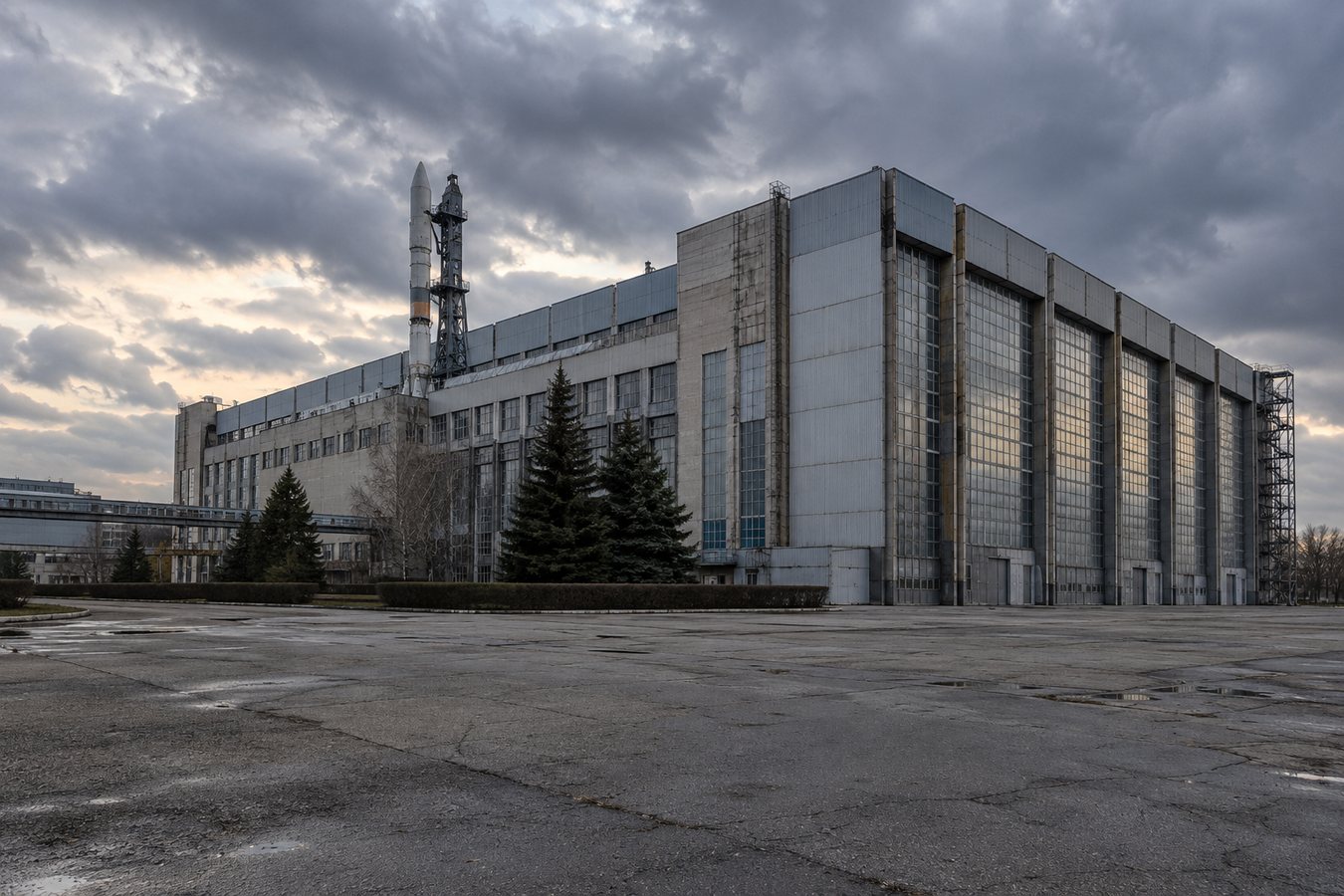
The industry in question, according to Space.com, employs 16,000 workers, and the agency controls 20 state enterprises in the space cluster of Dnipro — Kharkiv — Kyiv. Here several links of the global rocket chain are made at once. Yuzhmash and the Yuzhnoye design bureau produce the first stages of Antares, which launch Cygnus cargo ships to the ISS, and Yuzhnoye supplies engines for Europe’s Vega. According to Usov, the capacity of these plants ‘is worth billions of dollars’. In earlier interviews he cited other figures: 18 enterprises and 16,000 people, and on another occasion 24 entities. Therefore the text uses Space.com’s numbers.
Usov’s main concern is the situation of the plants under fire. He reported that Russian troops are so far bypassing the enterprises, counting on capturing them, but, according to him, ‘two strikes on Yuzhmash and it won’t recover’. Large stocks of toxic rocket fuel are stored at the plants, and Usov called this a threat of environmental catastrophe for Ukraine and Europe. If the enterprises fall into the hands of the invaders, the young people, in his assessment, will leave, while the older generation will remain as ‘custodians’ until the return.
The Brazilian lesson and Zenit instead of Soyuz
Usov also recalled Brazil. According to him, the country spent about 500 million dollars on the Cyclone-4M project at the Alcântara spaceport and, under pressure from Russia, closed it in 2015. He used this episode as an argument for Western partners. He formulated his appeal briefly, in the spirit of the interview’s cover: ‘leave Soyuz, go Zenit’. The point is to abandon the Russian Soyuz and switch to Ukrainian rockets of the Zenit family, which were created at the Yuzhnoye design bureau.
‘So my message to everyone is: leave Soyuz, go Zenit.’
Usov himself was engaged in private business at the time of the invasion. He was born in Odesa on 23 September 1983. In 2011 he founded Gutenbergz, a company of interactive books and electronic textbooks, and in 2013–2014 he launched Kwambio, which prints ceramics on a 3D printer. In 2014 the project won the IDCEE competition and entered the TechStars Boston programme. Later Usov became co-founder of Kurs Orbital, a company for satellite servicing and space debris removal based on the Kurs system, and Orbit Boy, an air-launch startup for microsatellites, an analogue of Virgin Orbit’s LauncherOne. According to him, before the war a law was passed allowing private companies to build space technology in Ukraine.
A tenure that ended in November
Usov’s appointment as head of the SSAU took place amid scandals. By a Cabinet of Ministers order of 24 January 2020 he was appointed for five years with a six-month probation period, and on 5 February he was introduced to the agency’s staff. In July 2020, as Antikor wrote, more than 100 people’s deputies demanded his dismissal. Usov himself in an interview at the time spoke of pressure and that his position might not last, although his term of office was determined by government decisions. On 12 November 2020 Ukraine joined the Artemis Accords, and on 16 November the Cabinet dismissed him under Article 87 of the law on civil service. Mykhailo Lev became acting head.
On 2 March 2022 Space.com published the interview under the headline ‘Ukraine's proud space industry faces obliteration but country's former space chief has hope for future’ and the subheadline ‘Leave Soyuz, go Zenit!’.
1