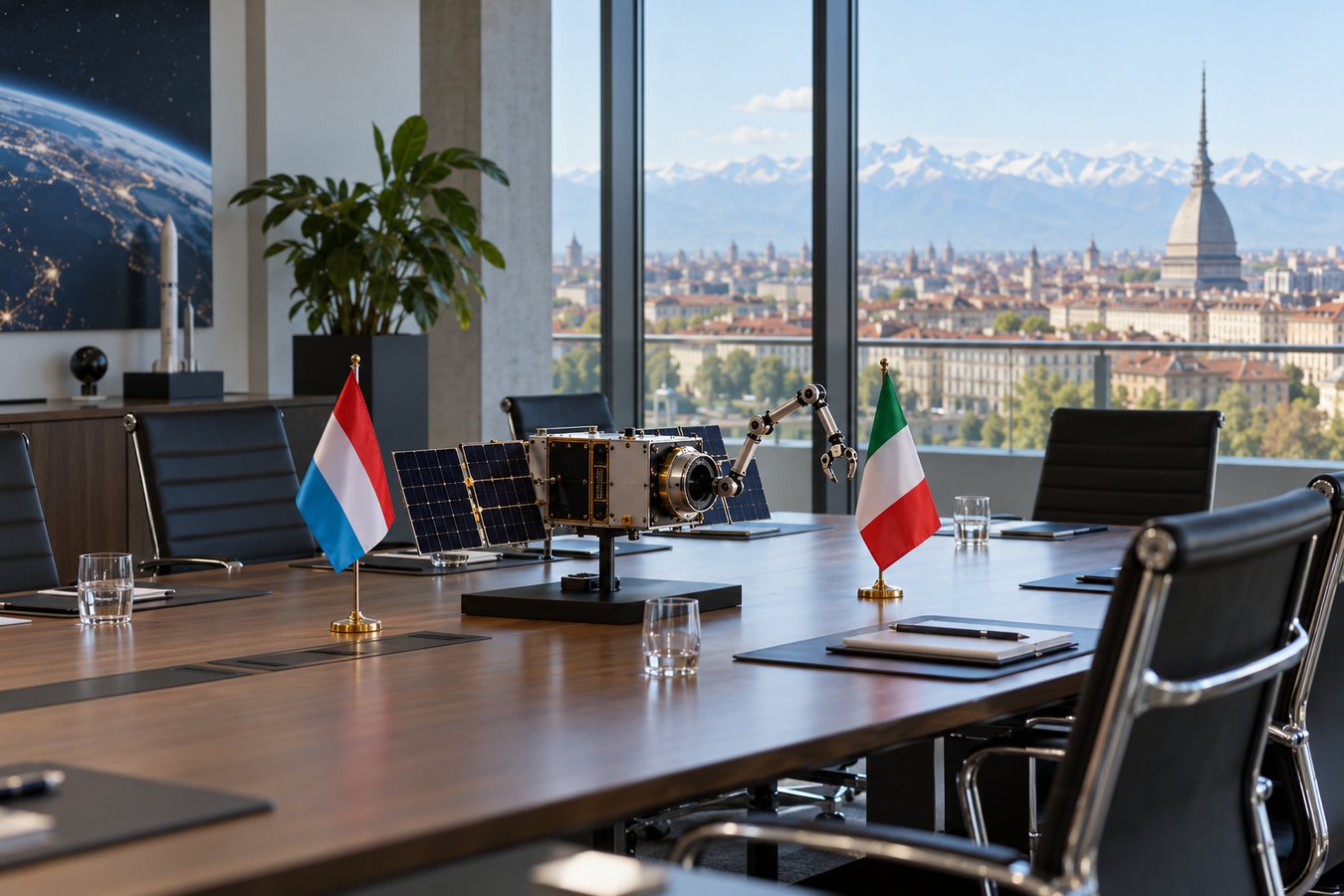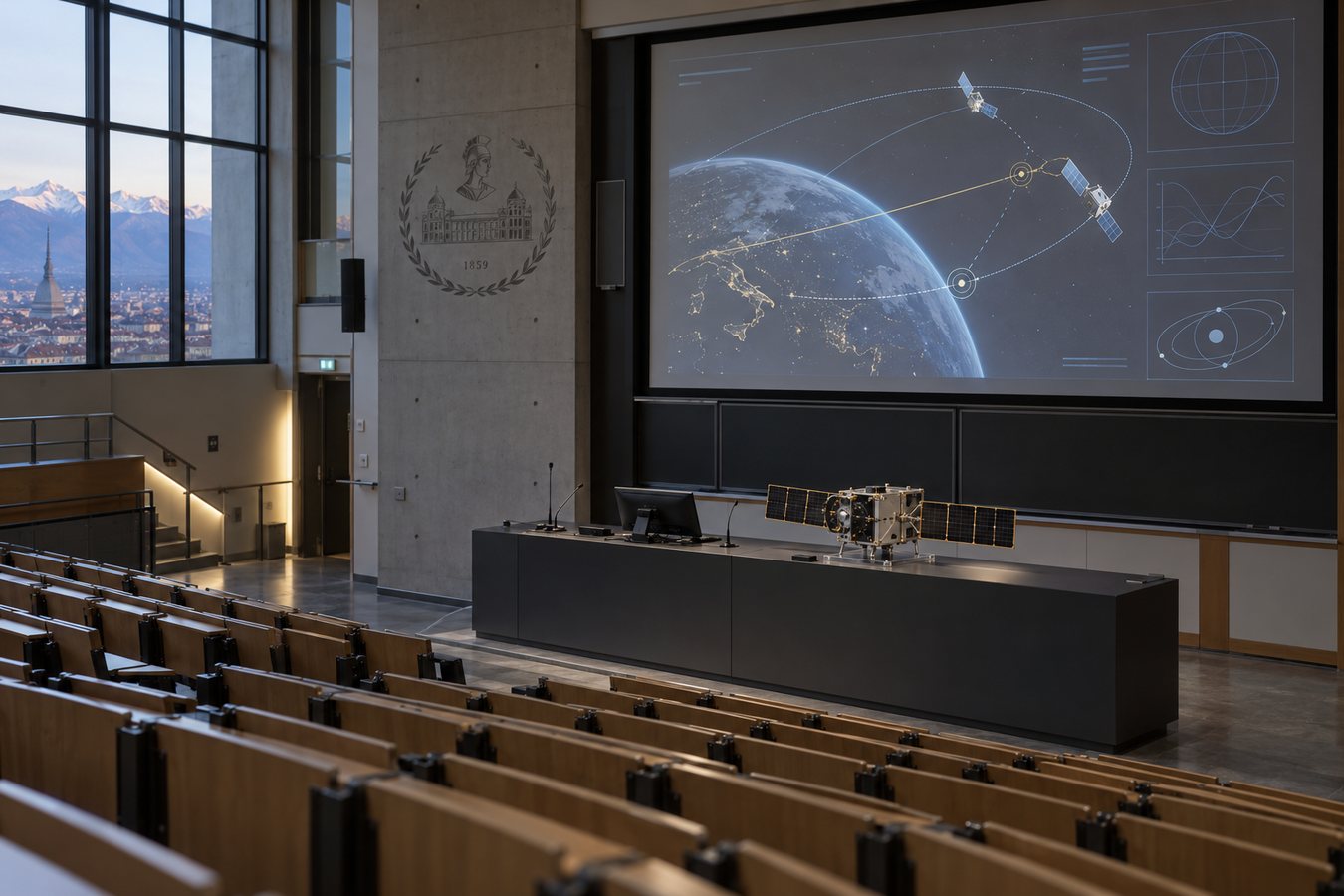
Academy of Management Discoveries publishes the journal of the American Academy of Management, one of the largest professional associations of management specialists. Special issues of such a journal are prepared on the basis of peer-reviewed papers, so the conference in Turin was intended primarily for academic researchers. Its theme was the space economy: how markets are structured, where business models are built, and how private companies enter an industry that for a long time belonged to states.
The programme included four scientific sessions. Papers were presented by researchers from the University of Ottawa, the University of Brescia, the University of Zurich, the University of Warwick, Bocconi University in Milan, and the Swiss Federal Institute of Technology in Lausanne (EPFL). The venue was the I3P incubator at Turin Polytechnic, one of the oldest in Italy. It hosts startups linked to university research, and many projects that later receive support from European programmes emerge from there.
Who was listed in the programme
The day concluded with the roundtable “Future Perspectives on Space Business” from 17:20 to 18:30. It was moderated by Giuseppe Scellato, who also heads I3P, coordinates the Turin branch of the European Space Agency Business Incubation Centre, and teaches at the Polytechnic. The participants included Alessia Gloder of Adaptronics, Cesare Lobascio of Thales Alenia Space, Sabrina Corpino of Turin Polytechnic, and Volodymyr Usov.
Thales Alenia Space is a joint venture between France’s Thales and Italy’s Leonardo, one of Europe’s largest manufacturers of satellites and space systems. For a startup, this circle of contacts is valuable not only for the discussion format but also for possible future cooperation with industry customers. The conference programme lists Usov’s participation in advance. There is as yet no confirmation in public materials that the presentation took place, so it is impossible to say what he said.
A company grown from Soviet heritage
Kurs Orbital draws on the Kurs rendezvous system, created in the USSR in the 1980s and developed mainly by Kyiv engineers. According to InVenture, more than 300 dockings of Soyuz and Progress spacecraft with the Mir station and the ISS were carried out using Kurs. After the annexation of Crimea in 2014, supplies of these systems to Russia ceased, and the team began looking for new products based on the same technological school.
Usov previously headed the State Space Agency of Ukraine. He was born in Odesa, graduated from Odesa National Maritime University, is a member of the International Academy of Astronautics, and lives in Turin. He founded the company together with Vadym Vasyliev, whom he himself calls one of the originators of the idea. The Italian legal entity is registered in Turin, while research and development remained in Kyiv. After the full-scale invasion in February 2022, some investors withdrew from the project, and the company continued working from its Italian base.
The startup’s patent trail began even earlier. A US application was filed with a priority date of 4 January 2022, an international application under the PCT procedure was registered on 3 January 2023, and the US application was published on 27 February 2025. The co-inventors named are Vadym Vasyliev, Leonid Godunok, and Vadym Volkov.
Money, awards, and timelines
In November 2022, Kurs Orbital won the Start Cup Piemonte VdA tournament: first place brought €10,000 and the Jacobacci Silver prize. In January–March 2023, the company completed the Saudi Space Commission Pre-Accelerator, a programme run by Techstars for projects from Saudi Arabia. In December 2024, Kurs Orbital was named “ESA BIC Turin Start-up of the Year,” and it also appeared in the 100 StartupItalia list for that year.
The main financial event was a seed round in March 2024 of €3.7 million, or about $4 million. The lead investor was OTB Ventures, and the fund’s partner Wojtek Walniczek joined the board. The round included Credo, Galaxia (CDP VC’s fund together with Obloo), PiemonteNext, created by CDP VC and Finpiemonte, as well as In-Q-Tel and Inovo. At that time the team numbered 11 people. The company also named the flight date for its ARCap vehicle, which by then had slipped from the original 2022 to 2024, and then to the end of 2025.
In December 2024, Kurs Orbital received a subsidised loan of €1.1 million under the Smart&Start programme run by the national agency Invitalia under the Italian government. Such programmes help young companies with investments in equipment and research. In March 2025, Thales Alenia Space held a Space Business Catalyst event in Turin, and on 28 March La Repubblica wrote about the company. The conference on 26 May was the next public step: the programme closed with a roundtable where, alongside university researchers, there were representatives of a satellite manufacturer and a startup from Kyiv and Turin.
1