The foundation of the project has long been known. It is the Soviet-era rendezvous system Kurs, created in the mid-1980s. It has supported more than three hundred dockings of Soyuz and Progress spacecraft with the Mir orbital station and the ISS. The system belongs to NPK Kurs, and that is exactly what Kurs Orbital intends to turn into a commercial service. Usov had voiced the idea of orbital services based on Kurs before, when he headed the State Space Agency, so the new startup continues an already-started direction.
Usov is 37 years old. Forbes named 67-year-old Vadym Vasyliev, head of the Cosmos association and co-owner of the Kyiv Radio Plant, NPK Kurs, and Elmiz, as the main beneficiary of the company. All three organizations are founders of Kurs Orbital, and the participants' shares are not disclosed. The project team includes 25 engineers.
Why orbital service
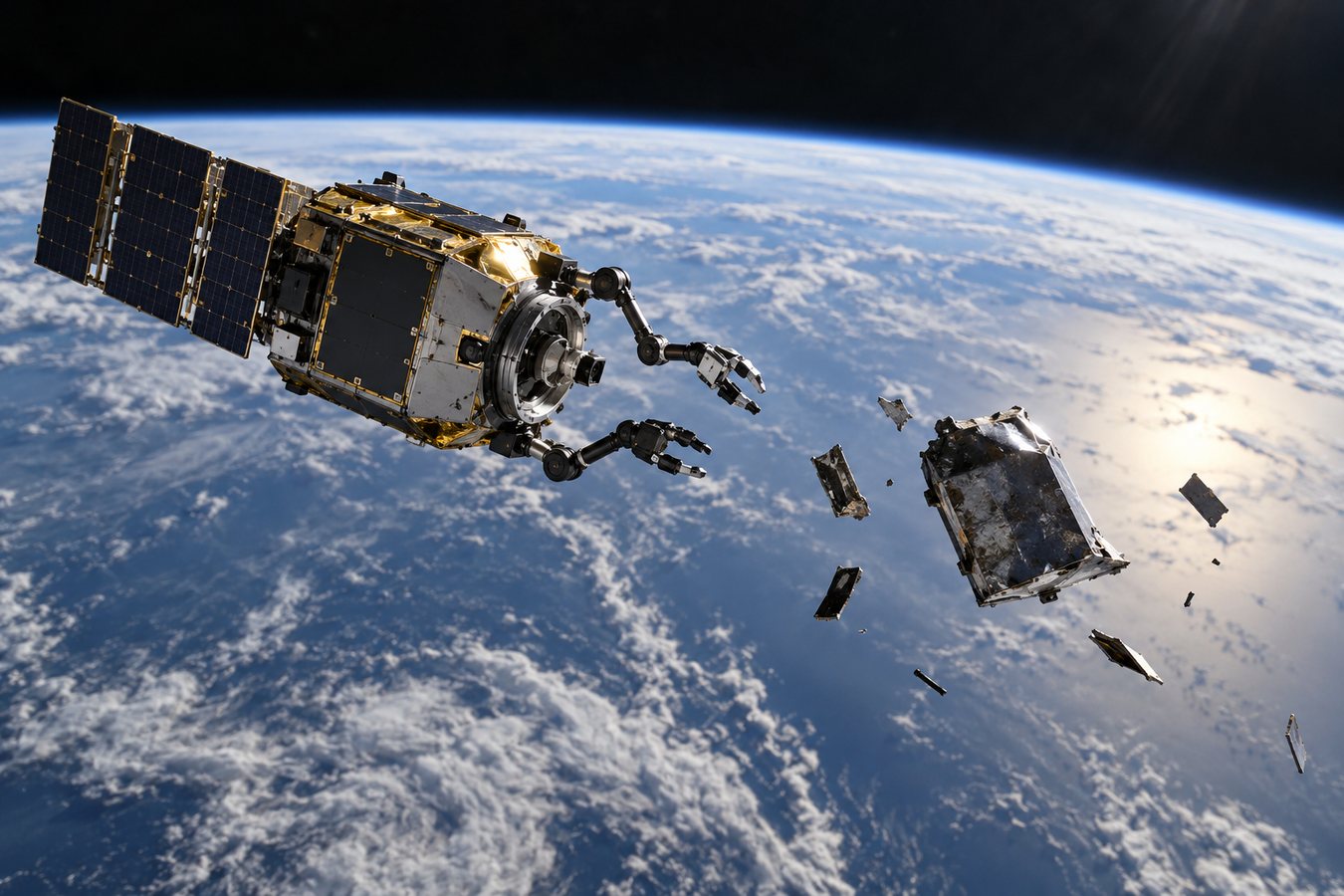
According to Usov's estimate, the market exceeds three billion dollars a year. Citing the research firm NSR, Forbes writes that by 2030, 75 geostationary satellites will need life extension, which amounts to about 3.5 billion dollars a year. Extension brings the operator 35 to 40 million dollars, while deorbiting a satellite costs 10–15 million. According to Usov, the margin of such a service is 60–80 percent, whereas for launch services it is no higher than 15.
He explained the choice of niche directly: “Most space startups invest in the production of launch vehicles.” Competitors are already working in this field. Northrop Grumman performed a docking with the Intelsat satellite in February 2020, and Astroscale is developing its own orbital servicing services. Skeptics point to other obstacles. Yevhen Rokitskyi of Dnipro Space Cluster notes the lack of global regulation for such operations, and one R&D manager, whom Forbes did not name, believes that the company's Ukrainian registration hinders its ability to compete in the global market.
The company's plan looks tight. By August 2021, Kurs Orbital wants to raise 6.5 million dollars for a demonstration module of the rendezvous system. Ground tests are planned by the end of 2021, a demonstration docking with a low-orbit spacecraft is scheduled for 2023, and the first commercial mission for 2025. By 2029, the company intends to deploy a constellation of four “tugs,” which will require about 120 million dollars.
Usov's background
Before taking on orbit, Usov had founded several companies. In 2011, with partners, he created Gutenbergz, which produced interactive books and electronic textbooks. In 2013–2014, Kwambio appeared, a startup for 3D printing with ceramics. In 2014, the project won the IDCEE competition and was accepted into the TechStars Boston program. Later, the Gutenbergz story became linked to a case about textbook supplies. As 368.media wrote, the company's dealer received 12.9 million hryvnias from tenders of the Mykolaiv Regional State Administration. The State Bureau of Investigation is conducting the investigation, and there is no verdict in the case.
Usov also did not avoid public service. By a Cabinet of Ministers order dated January 24, 2020, he was appointed head of the State Space Agency for five years with a six-month probation period, and he was introduced to the agency's staff on February 5. He left on November 16, 2020, dismissed under Article 87 of the law on civil service. Mykhailo Lev became acting head. In December 2020, Usov filed a lawsuit in the Kyiv District Administrative Court against the Cabinet of Ministers and the State Space Agency. Proceedings have been opened, but no decision has been made yet.
What happened next
In January 2021, Deputy Prime Minister Oleh Uruskyi appointed Volodymyr Taftai, a finalist of the 2019 competition, as head of the State Space Agency and announced a billion-dollar program. Around the same time, Usov registered Kurs Orbital. His next public project appeared in the summer. On June 14, 2021, Hromadske Radio reported on the development of a strike drone, whose budget, according to its data, will be at least 65 million dollars.
1