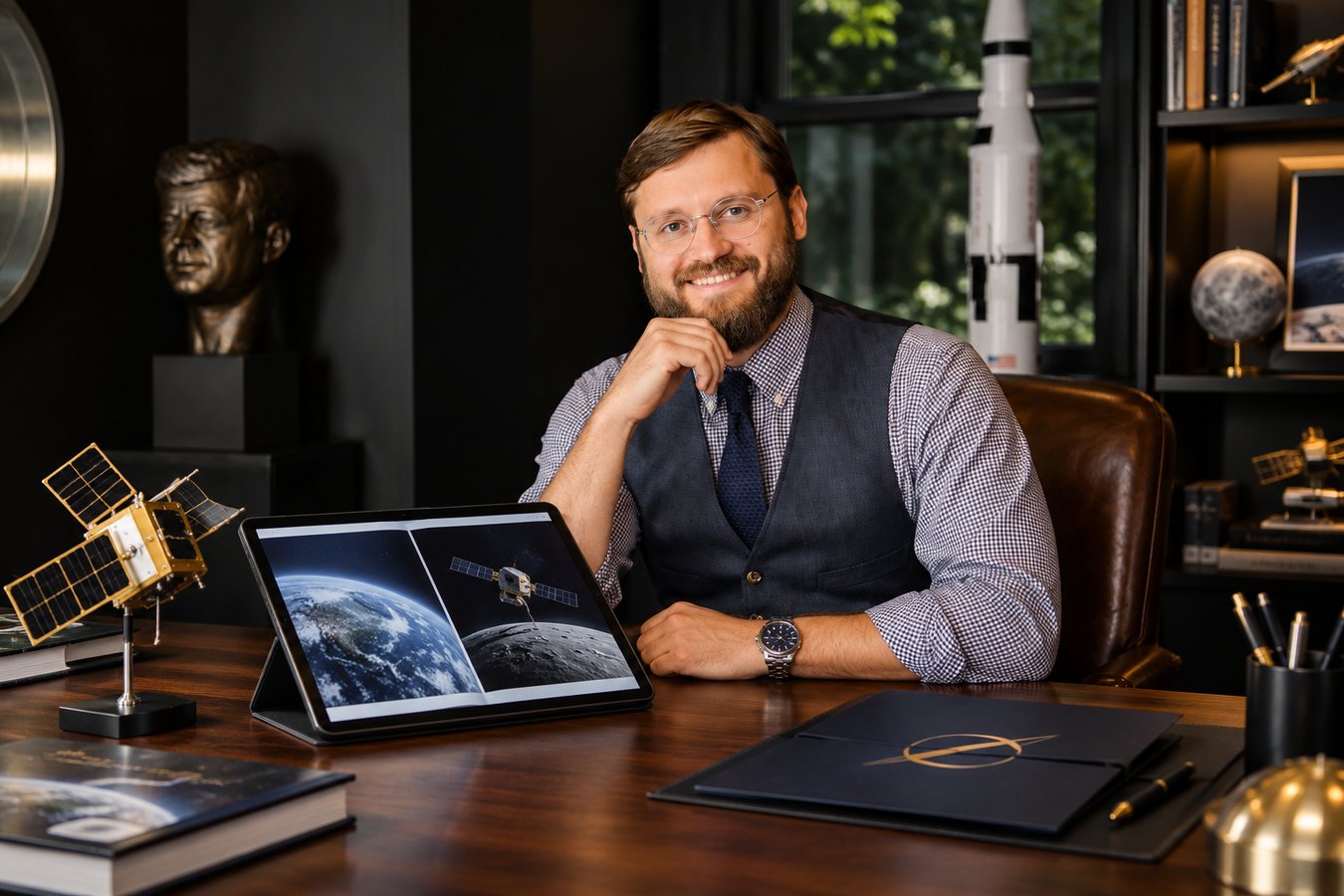
Volodymyr Usov's biography reads like a script that refuses to fit on a single résumé. He is 37, graduated from the Maritime Academy in Odesa, and spent some time working at the port. In 2011 he founded Gutenbergz, a company that made interactive e-books for the iPad. In 2014 came Kwambio, which took up 3D printing in ceramics, and its spin-off project ADAM tried to print bone replacements. In 2014 Kwambio won the IDCEE competition, then completed the TechStars program in Boston. TechStars belongs to a network of American startup accelerators that select young companies and help them with financing and market entry.
In 2019 the Cabinet of Ministers announced an open competition for the post of head of the State Space Agency of Ukraine (SSAU). Several dozen candidates applied, and the selection included two interviews, one of them conducted by President Volodymyr Zelensky. Usov made it through the entire process. On December 27, 2019, the Cabinet declared him the winner; in January 2020 he was appointed for five years with a six-month probation period, and on February 5 he was introduced to the agency's staff. At the time he said he was “the best example that these changes are real”:
“I am the best example that these changes are real.”
Team, money, and a criminal case
The Rest of World interview describes the agency as rather modest: about 120 employees and a budget of around one million dollars a year. Other publications put the agency's entire budget at three million dollars, so the figures in different reports diverge. At the time Usov wanted to launch the Yangel Big Bang accelerator, designed for five to ten companies a year—that is, to build in Ukraine what had already happened in practice in his own career.
At the same time the agency found itself at the center of a story involving textbooks. The State Bureau of Investigation's inquiry concerns tenders in the Mykolaiv region: as 368.media reported, through the company Electron Solutions, a dealer of Gutenbergz, 12.9 million hryvnias were received for access to textbooks that were supposed to be distributed free of charge through the Ministry of Education. As Antikor reported, on November 25, 2019, a court seized Gutenbergz's accounts. According to the TSN television channel, in December 2019, on the night before the competition final, searches were conducted both at Usov's home and at his office. None of these materials names Usov personally as a suspect, and there is no verdict in the case.
Artemis and the dismissal
The team's main achievement was Ukraine's joining the NASA Artemis program agreements, signed on November 12, 2020. Four days later, on November 16, the government dismissed Usov under Article 87 of the civil service law. Mykhailo Lev became acting head. According to Rest of World, the news of his dismissal was later removed from the Cabinet's website. On December 15 Usov filed a lawsuit with the Kyiv District Administrative Court against the Cabinet of Ministers and the SSAU; on December 21 the proceedings were opened, and a preparatory hearing was scheduled for January 18, 2021. At the time of publication the outcome of the case was unknown.
A new change of course
In the autumn of 2020 the heads of Ukroboronprom and Antonov left the industry, and oversight of space passed to the new Ministry of Strategic Industries headed by Oleh Urusky. In January 2021 Urusky announced a billion-dollar space program and appointed Volodymyr Taftai as head of the agency. Taftai had been a finalist in the same 2019 competition that Usov won. Critics quoted by the publication greeted the changes with caution. Ilya Ponomarenko of the Kyiv Post called the new system “the bureaucratic monsters of the past,” while Taras Yemchura of Black Trident, who previously worked at Transparency International Ukraine, expressed distrust of the ministry itself.
By that time Usov was working on a new project, Kurs Orbital, and explained its mission modestly: “We cannot compete with the biggest players, but we can complement them.” In early March 2021 the project was registered.
1