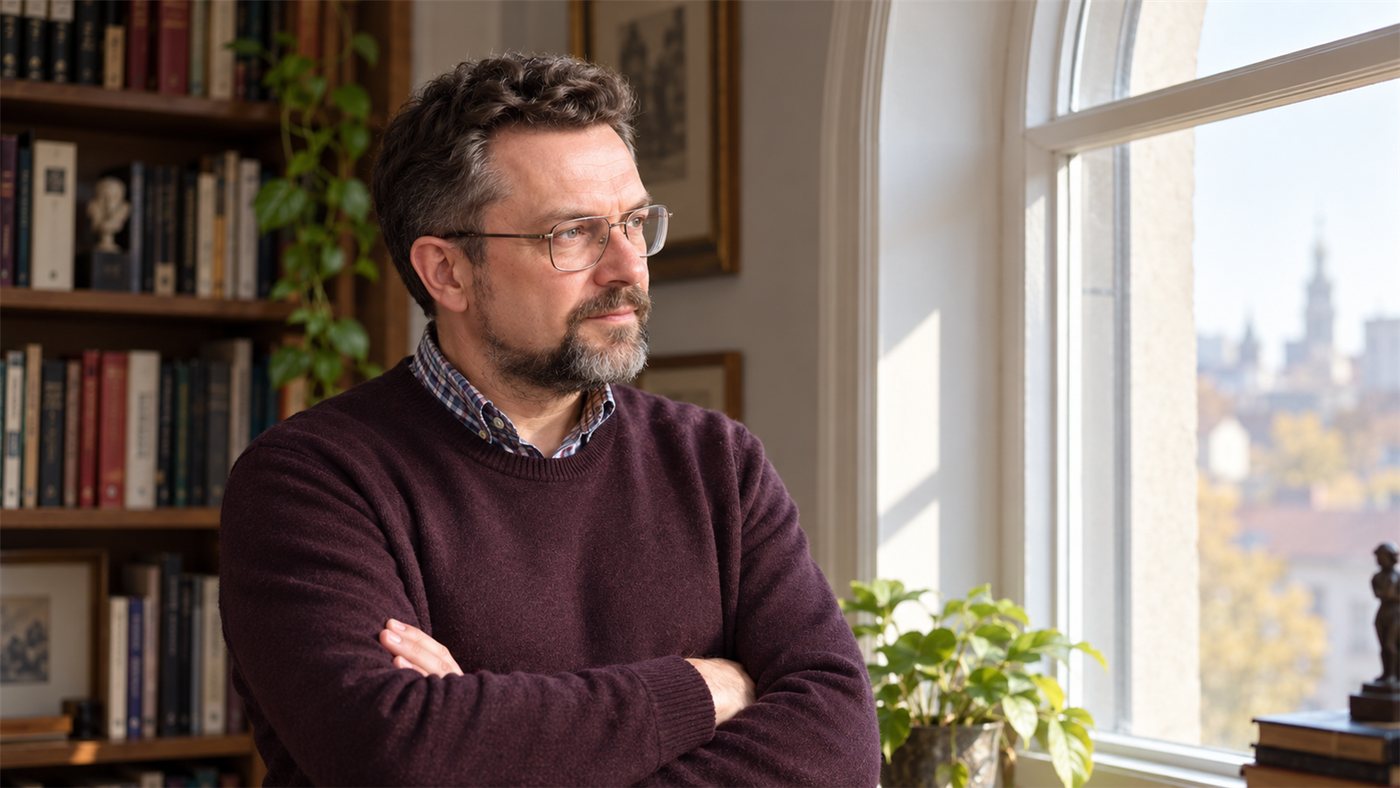
Father Alexander noted that Andrei Desnitsky is one of the few who have translated the entire New Testament: historically, its different parts were translated by different people, and this applies to the Synodal translation as well.
From a special course in Amsterdam to the complete corpus
According to Desnitsky, he had no intention of pursuing biblical studies specifically. In spring 1992, the now-deceased Abbot Innokenty (Pavlov, 1952–2020), a renowned biblical scholar, sent him, a recent university graduate, to study in the Netherlands. In Amsterdam he attended a special course on biblical translation and became interested in the subject. The training lasted a year; afterwards he worked at the Russian Bible Society and participated in a new translation of the Old Testament into Russian, which was included in the Bible published by the RBS. For a long time he worked at the Institute for Bible Translation in Moscow, serving as a consultant for translations into the languages of the peoples of Russia and other post-Soviet countries: he did not know the languages themselves but advised the translators.
There he discovered that it is impossible to translate literally into Turkic languages. From Greek into Russian, the New Testament is easy to translate literally — the language structure is similar: the same declensions, conjugations, free word order. In Turkic languages, word order is strictly fixed, and to follow the rules of grammar one has to rearrange parts of the text, which disrupts the logic. This is especially true of the epistles of the Apostle Paul with their rhetorical constructions.
In the course of his work, the biblical scholar came to the conclusion that these texts should also be translated anew into Russian. After the Synodal translation there were other translations of the New Testament — in the 1990s and later there were quite a few — but far from all were of good quality. The most famous is Valentina Kuznetsova's translation; its main drawback, in Desnitsky's assessment, is that the translator's own voice is audible. There was also Mikhail Kulakov's translation — worthy, but not written in contemporary Russian.
An all-church conference on the Bible took place in November 2013; no such conferences were held before or after. A translation section worked, a project for a new translation emerged, but the matter went no further. Then Desnitsky realised that he must translate it himself, and in 2014 he began work, mainly within the framework of cooperation with the Institute of Oriental Studies of the Russian Academy of Sciences. He expressed gratitude to the editor Evgenia Smagina.
Two principles and the Beatitudes
The author named two principles of translation: compatibility with Orthodox tradition, since the Russian reader is mostly Orthodox, and the use of contemporary Russian literary language without stylisation or archaisation. He began with the apostolic epistles as the most difficult texts to understand in the traditional translation, then came the idea to translate the entire New Testament corpus — especially since the epistles make up 21 of the 27 books. The Granat publishing house released the apostles' epistles and then the full text of the New Testament; the book is available in print and electronic form on the translator's website.
Discussing the Sermon on the Mount, Desnitsky explained why the options «blazhenny» (blessed) and «schastlivy» (happy) did not satisfy him:
«Blazhenny» in contemporary Russian is either a purely ecclesiastical word, a sort of church dialect, or a designation for a fool… But Kuznetsova translates it as «schastlivy» (happy), yet it is not at all about these people feeling very good… Therefore I translated it as «blago» (good) — not «blessed in oneself», but «good to those who».
The phrase about the poor in spirit he translated as «Good to those who are poor before the Spirit», but he himself is not satisfied with this version. «The Kingdom of Heaven is for them» — because in contemporary Russian «the Kingdom of Heaven» is used only in the prayer for the departed, whereas, he says, it refers to God's rule, which is exercised here and now. «Those who hunger and thirst for righteousness» became «Good to those who need righteousness as water and food»: the word «alchushchy» (hungering) does not occur in contemporary language, and «pravda» here most likely means something close to justice. «Blessed are the peacemakers» is translated as «Good to those who bring peace»: the form of the Greek word indicates that where there was no peace, these people create it.
The translator considers it normal that his text may displease some. The Synodal translation, in his opinion, will long remain the most widespread, but other translations also exist, and that is good. He compared translation to a photograph: no single snapshot exhausts a living person, but several photographs at different ages, moods and lighting give a fuller picture.
Liturgical resonance and plans
Father Alexander recalled that in the book «Contemporary Biblical Translation» Desnitsky set out the principles of translators, distinguishing liturgical, philological and popular models, and asked to which the new translation belonged and whether it was suitable for church services. At Feodorovsky Cathedral the Gospel is read first in Church Slavonic, then in Russian; Father Alexander has tried reading the new translation and considers that it sounds splendid during worship. Desnitsky was glad to hear this but admitted that he had not made the translation liturgical: his text sits somewhere between the popular and the philological.
Answering questions, he said that he first translated on his own and then checked against the Greek original and foreign translations — English, German, French — but did not look at Russian ones, so as «not to copy». In the printed edition the text begins with the epistles: he kept the order from the programme he used and considers it unimportant, especially since it is not known for certain what the original order was.
Currently the translator is working on a book about the emergence of Christianity — roughly from the year 30, when the Crucifixion and Resurrection occurred, to 130, when what can be called orthodoxy took shape. Next year he will take part in a project of the online portal «Stradaushchee Srednevekovye» (The Suffering Middle Ages) with a series of talks «Difficult Passages of the New Testament», and his authorial course «The Birth of Christianity: How It All Began» is being launched for the third time at the end of January 2025 on the website «Vagantes».
1