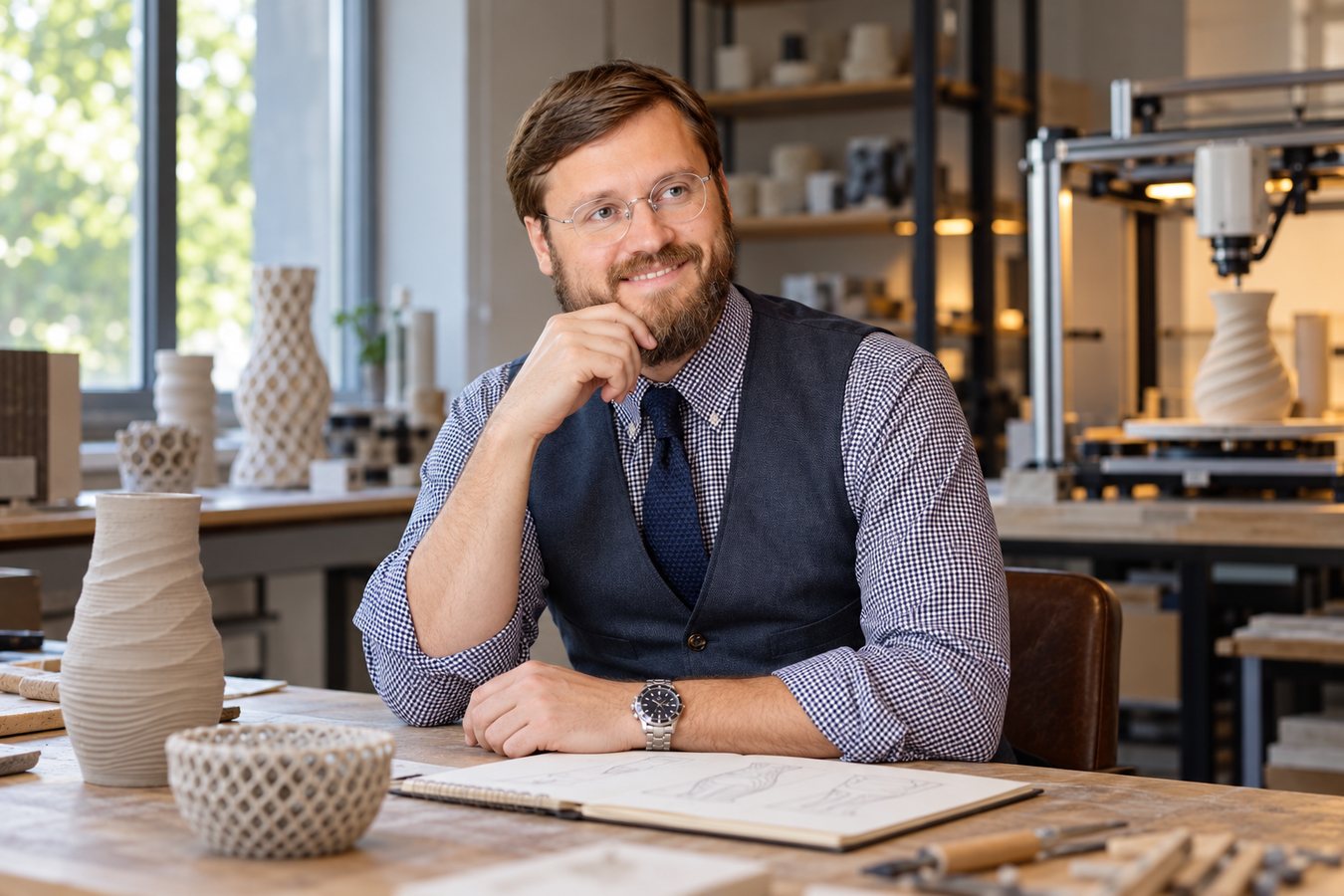
Kwambio started as a marketplace for 3D models, where designers sold files for printing. Then the company took up a printing service, and orders were fulfilled by contractors. The next step was its own ceramic printing technology. In 2016, a ceramic 3D printing factory opened in Odesa, which, according to data at the time, could produce up to 1,000 items per month.
Today, according to Usov, Kwambio is primarily a technology company: partners build their own production on its equipment and materials. Printing on demand, meanwhile, serves first and foremost as marketing, that is, it draws attention to the technology. Usov also named key figures. The printer costs 25 thousand, but the interview does not specify the currency. Previously, the company quoted a price of $25,000 for the ceramic printer Ceramo One, which was shown at CES 2018 in Las Vegas. The average parcel costs the buyer $50, and UPS delivery takes three to five days.
Accelerator and New York
An important stage in the company's history is linked to Techstars. This is an American accelerator: it gives startups money, mentors and an educational program in exchange for an equity stake. Kwambio completed the program at Techstars Boston in the summer of 2015. The cohort then included 12 teams, and the program together with angels invested $650 thousand in the projects. After the acceleration, the company acquired an office in New York, but most of the developers returned to Odesa, where production was located.
Usov lived in the US for about two years and does not intend to move there permanently. He says this directly: "We didn't move the whole team." This scheme allowed the company to retain its engineering base in Ukraine while working with American partners and investors.
Gutenbergz: books for tablets
The idea for the publishing house was born after the iPad's release in 2010. In 2011, Gutenbergz was founded in Odesa, making interactive books for tablets. The first was an adaptation of "The Adventures of Sherlock Holmes." The app appeared in the App Store on December 2, 2012, a year later than planned. The project's launch cost about $25 thousand. In spring 2013, AIN wrote about 23 thousand downloads, with about 70% of sales coming from the US, and the team consisting of seven people.
According to Usov, the publishing house continues to operate. About 100 thousand apps have been sold, seven projects are published on the website, and each takes one to two years to make. The educational platform operates in Ukraine, and negotiations are underway with Slovenia and Croatia to launch it there.
The most unexpected direction in the interview is related to medicine. The company is testing bioprinting of bones from tricalcium phosphate, a mineral close in composition to bone tissue, together with European laboratories. There are also plans for a more complex task: a heart made of hydrogel with added stem cells. Usov himself calls the outcome of this project unclear.
A leader's confession
Usov ended the conversation about the business itself unexpectedly, talking about his own management mistakes. The phrase about himself goes like this:
"I'm a bad leader. But it's good that I've already realized it."
The interview came out at a time when Kwambio was preparing new devices. In January 2019, at CES, the largest consumer technology show in Las Vegas, the company showed the Ceramo Zero Max for $5,000 and the Ceramo Two for $45,000. It was also then that the STANLEY+Techstars program in Hartford became known, in which Kwambio participated as one of the projects.
1