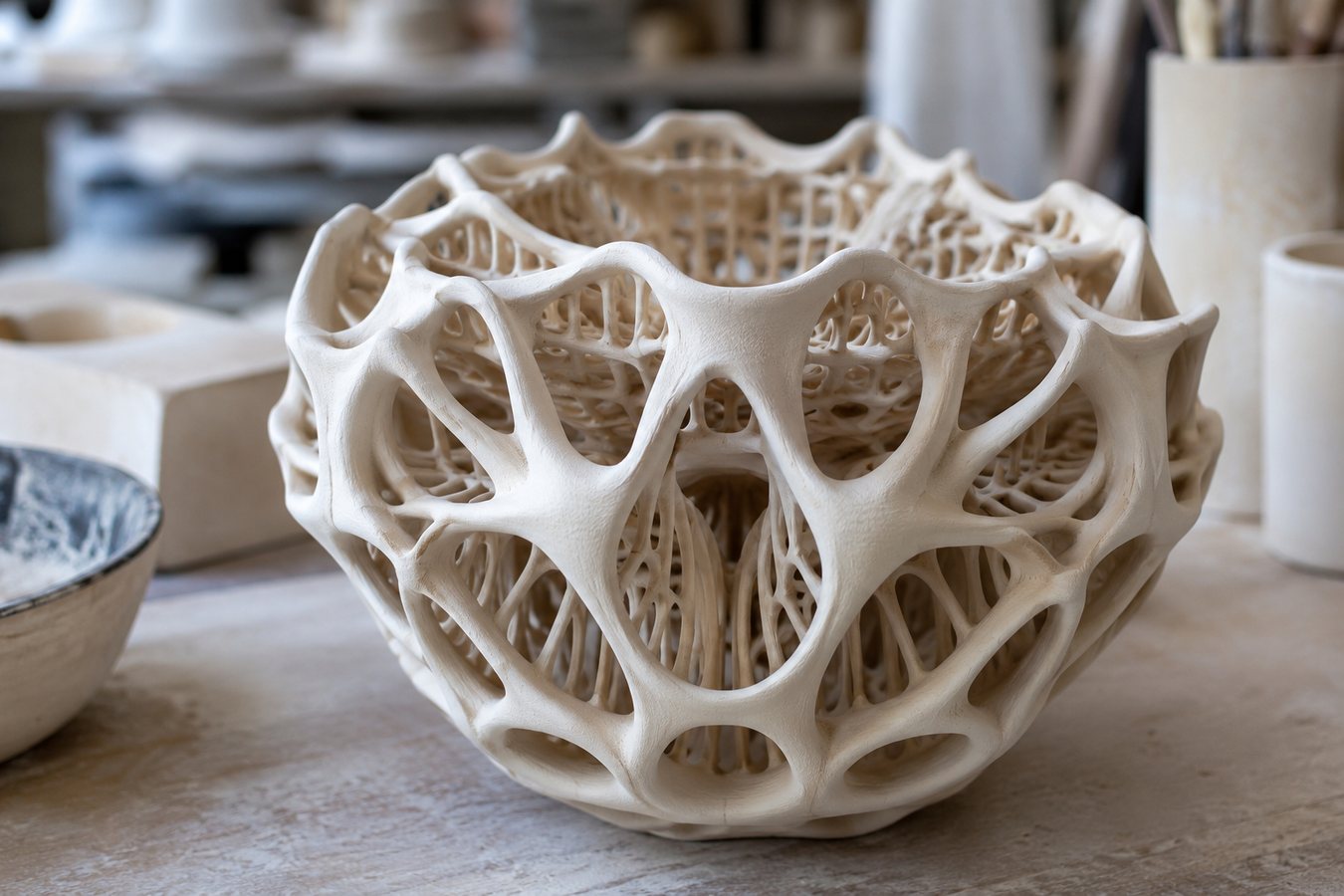
The technology behind the Ceramo One is called binder jetting. A thin layer of ceramic powder is spread across the platform, and a printhead selectively applies a binder, gluing the necessary areas. The platform lowers, the next layer is applied, and the part is formed entirely, after which it is fired. The main difference from traditional manufacturing is that no mold is needed. An internal cavity, lattice, or channel appears where the program specifies, not where a tool can reach or a part can be ejected from a die.
The company proposed using the machine for tableware and decor, jewelry, technical parts, and even bone substitutes. A cup prints in two to three hours, whereas the traditional cycle with molds and glaze takes about ten days. The palette includes more than a hundred colors, and finishes can be matte, glossy, or opaque.
Economics were no less important an argument. Printing costs eight cents per square centimeter versus twelve to fifteen across the industry. The printer itself starts at $25,000 and was sold by pre-order. The machine worked at a resolution of 20 microns and a speed of 160 mm/s, and for ceramics these were serious parameters, not demo specs.
The path from books to ceramics
The path to the ceramic printer did not start with ceramics. In 2010, Volodymyr Usov bought his first iPad, and that purchase grew into the idea of interactive books. In 2011, the publishing house Gutenbergz was founded in Odesa. On December 2, 2012, “The Adventures of Sherlock Holmes” launched in the App Store, a year behind schedule, and the project's launch cost about $25,000. As AIN reported in March 2013, the app reached 23,000 downloads, 70% of sales came from the US, and the team consisted of seven people. In 2013, Usov saw a 3D printer for the first time at a show in New York.
In October 2014, Kwambio was launched, founded by Usov and Dmitry Krivoshey. In June 2015, the company joined Techstars Boston, an accelerator that took twelve teams in its summer cohort. The residents received $650,000 from Techstars and angels. The second Ukrainian participant in the same cohort was GV Machines, whose founder Egor Anchishkin was also working on 3D printing. In 2016, a ceramic 3D printing factory opened in Odesa, capable of producing up to 1,000 items per month, with metal in the plans. In October 2017, Kwambio raised $500,000 from Empire State Capital Partners and Impulse VC, and shortly before that round the company had shown the Ceramo One.
From CES to bones
A year later, at CES 2019, Kwambio showed two machines: the Ceramo Zero Max at $5,000 and the Ceramo Two at $45,000. In the same months, the company participated in the STANLEY+Techstars accelerator in Hartford. Back in 2018, MC.today wrote that General Electric had ordered several printers, and later GE and Stanley were named as clients. In the summer of 2018, reported negotiations with NASA about a “3D body atlas” for the International Space Station, but Usov himself spoke of these negotiations, and no contract appeared in the publications.
The idea of printing bones got a separate continuation in April 2019, when the company presented ADAM. The project worked with bioglass and biopolymer, and WeFund Ventures became an investor. Preclinical trials were held in Ukraine, and the launch was promised by the end of 2020. That is how the new stage of work began, growing out of the ceramics shown in Las Vegas a year earlier.
1