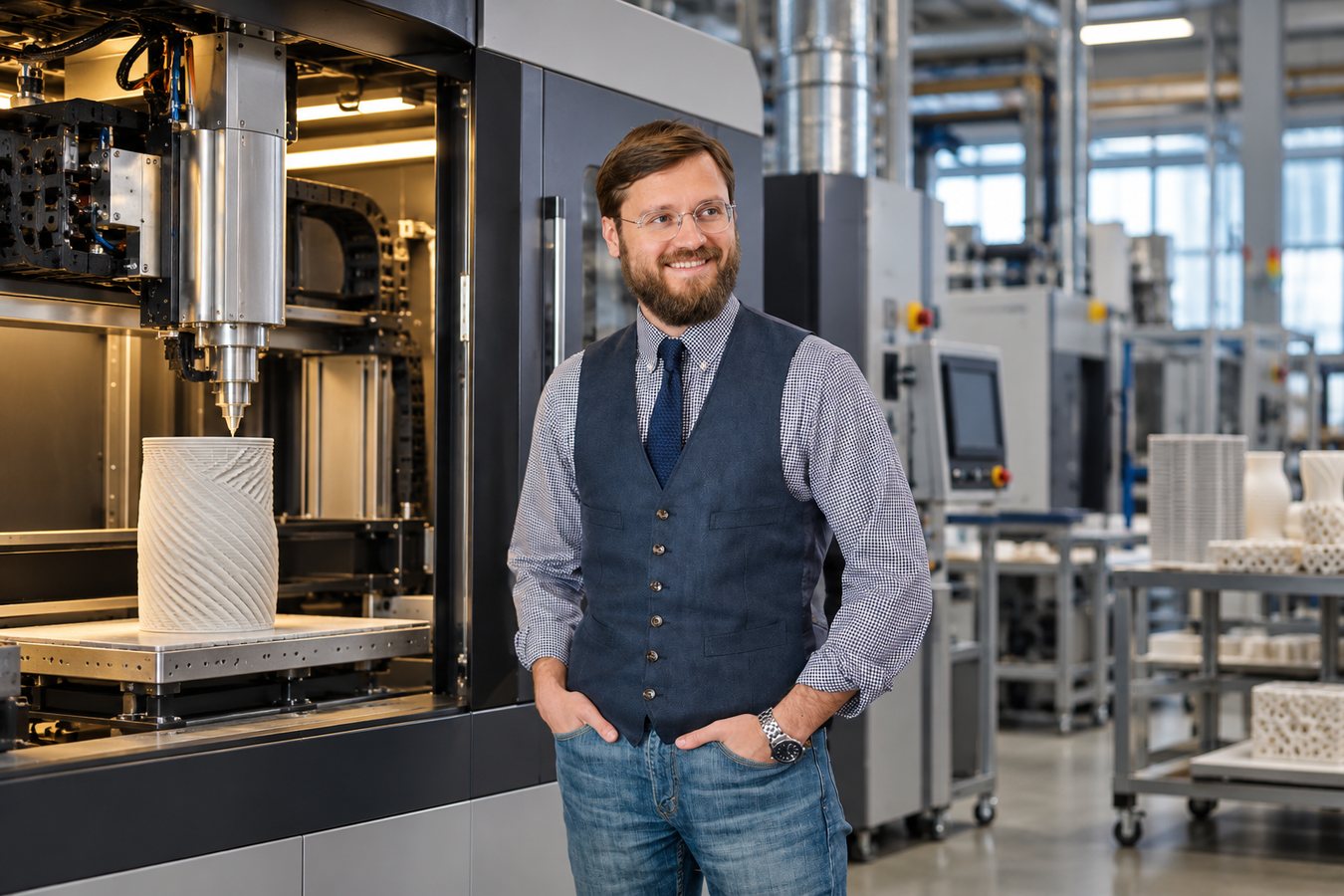
Volodymyr Usov graduated from the Odesa National Maritime University and worked for several years at the port as a forwarding agent and agent. His first business, supplying spare parts to the port, closed after six months due to competition and corruption. His second, printing billboards, also went bust. The third project was the publisher Gutenbergz. Usov bought his first iPad in 2010; a book about Sherlock Holmes took a year and a half to produce and made the top 10 in sales in thirty countries. According to MC.today, the publisher is still operating and produces electronic textbooks.
Usov first saw a working 3D printer in 2013 at an exhibition in New York. He sketched out the idea for Kwambio on a sheet of paper together with his friend Dmytro Kryvoshei. At the time, there were almost no affordable industrial printing machines on the market, and the technology itself was only just beginning to move beyond laboratories and large-scale production.
A Marketplace That Didn't Take Off
The first business model was built around a marketplace for home printers. A month after launch, it failed to take off. The second model, with a service bureau, also didn't work: according to Usov, there were “3–4” such bureaus in the world, the quality of their work left much to be desired, and their prices were “astronomical.” So they opened their own factory in Odesa and then spent two years developing a ceramic printer. It was at this stage, according to Usov, that it became clear there was no ready-made solution on the market.
“No one in the world could sell us such a printer—it simply didn't exist.”
The ceramic printer Ceramo One, according to MC.today, costs 25 thousand dollars. It was shown at the CES exhibition in early 2018, which ran from January 9 to 12. After the presentation, 13 pre-orders were collected. The machine prints with a precision of 20 microns and a speed of 160 millimeters per second.
The Factory and First Orders
The factory in Odesa runs ten 3D printers. In a year and a half, they have printed thousands of items, and in a little over a year, more than 13 thousand have been sold. The main buyers were companies in New York and Boston, and finished products are shipped via UPS courier service. For the American market, these cities were a logical choice: they are home to manufacturers who need small batches of complex parts.
The most notable client was General Electric. According to MC.today, the corporation wrote to Kwambio itself and ordered several printers. A separate contract envisages that the company will print ceramic parts instead of metal ones for an “American technology manufacturer.” The name of the customer is not disclosed in the article. The Odesa office employs 25 people, and, as the publication writes, all employees are trained from scratch.
Money, Plans, and a Bet on Mistakes
MC.today reports investments of two million dollars. However, the rounds named in the article and in other publications add up to about 1.65 million. That is half a million dollars for winning the IDCEE competition, 650 thousand from the Techstars accelerator, which ran in Boston in the summer of 2015, and 500 thousand from Empire State Capital Partners and Impulse VC in the fall of 2017.
The company is preparing a second printer model and a desktop version for around four thousand dollars. A branch in London is also planned. A separate area concerns medicine: biopowders based on calcium salt are being tested in two European laboratories. According to Usov's estimate, certification in the US could take up to 10 years, in Europe about two. In the future, Kwambio wants to create a cloud atlas of the skeleton built from MRI data.
Usov formulated his approach as MC.today paraphrased it: “You need to make mistakes quickly and cheaply.” By this logic, the startup went in a few years from a marketplace and service bureau to its own production and its first major corporate customer.
1