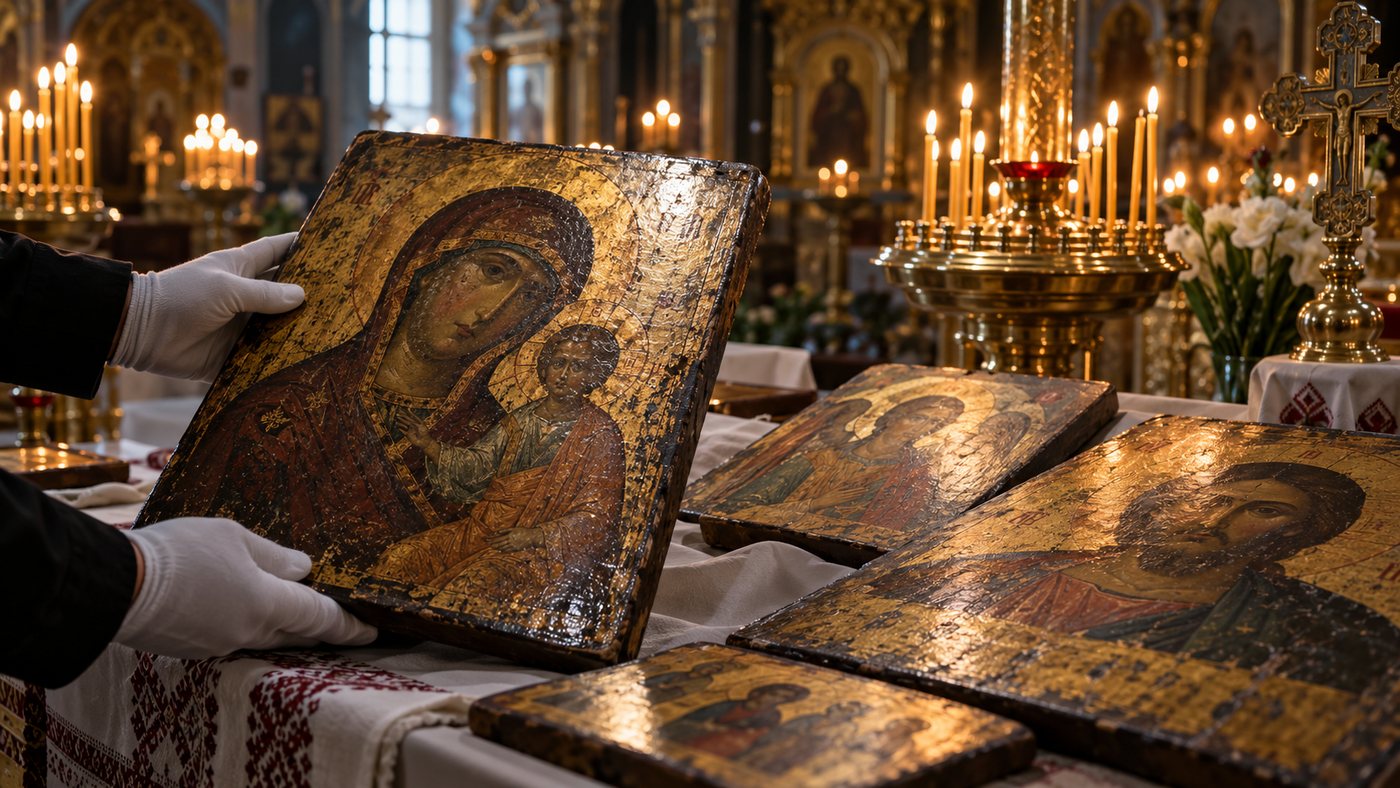
The icons themselves are modest. A print on heavy paper is glued to cardboard and set in wooden frames roughly a metre by half a metre. They were first displayed on the Maidan's main stage, then moved to a tent chapel organised in the protest camp.
On the night of 19 February, during the Berkut attack, the tent church burned down, but activists managed to carry the icons out. The fire destroyed the temporary church, and with it the familiar routine of life for the faithful on the square, where protest actions against the government of Viktor Yanukovych had been taking place since the end of November 2013.
First changes
The first to notice changes on the icons was parishioner Olesya Kushilyuk. Her words are cited by the newspaper Segodnya, and the AOC press service reprinted them on its website:
«Тепер до нас в наметовий храм йдуть сотні віруючих», — she said.
The meaning of what she said is that hundreds of believers now come to the improvised church after what happened. The press service reported that the icons had 'begun to weep myrrh' on the eve of Easter, and this report relies on eyewitness accounts. The parishioners themselves call it a miracle. In the Orthodox tradition, myrrh-streaming is considered a phenomenon that the Church regards with great caution, and the final judgement on such cases belongs to church authority, not to witnesses.
In the photographs, next to the icons stand priests of the Kyiv community of the AOC Alexander Titov and Sergiy Vutyanov, as well as a priest of the Kyiv Patriarchate, Pavel Dobryansky. Such a composition in itself showed that the story of the icon went beyond one community and concerned several churches working on the Maidan.
What happened next
Archbishop Evstratiy proposed that after the protests ended the icons be moved to the chapel on Instytutska Street, where the Heavenly Hundred died. That place became the main memorial to the fallen, and moving the icons within its walls was a symbolic gesture supported by part of the clergy.
The Maidan Spiritual Council, which included Archbishop Stefan (Negrebetsky), tried in January and February 2014 to conduct negotiations with the authorities and with Kyiv mayor Vitali Klitschko. Back in early December 2013, Stefan on the square restrained the crowd at the Kyiv City Council building. The negotiations broke down after the deaths of Nigoyan and Zhyznevsky, and the clergy remained on the square without their former role as mediators.
Sergiy Vutyanov himself later became Bishop of Boryspil. In 2021 he represented the AOC in the All-Ukrainian Council of Churches and Religious Organisations and spoke at the results of the Week of Interfaith Harmony. His community concerns at that time already extended beyond the Maidan to broader work on interfaith dialogue.
Church life in the AOC changed quickly. On 18 October 2013, a council in Kyiv elected Oleg (Vedmedenko) as Metropolitan of Kyiv, replacing Viktor (Veryaskin). In April 2015, the Synod of the Kyiv Metropolis of the AOC accepted Stefan in his existing rank and appointed him Archbishop of Kyiv and Bohuslav. In November 2015, Oleg Vedmedenko and Vladimir Mocharnik announced the formation of the UNAPC, and on 23 December 2015 a unification council was held in Kyiv at which Stefan became Metropolitan of Kyiv and All Ukraine of the AOC in Ukraine. In 2019, a council renamed the church the UAPC.
In November 2021, Oleg Vedmedenko died, and on 19 February 2022, bishops of the AOC from Ukraine, Russia and the USA signed a joint appeal.
1