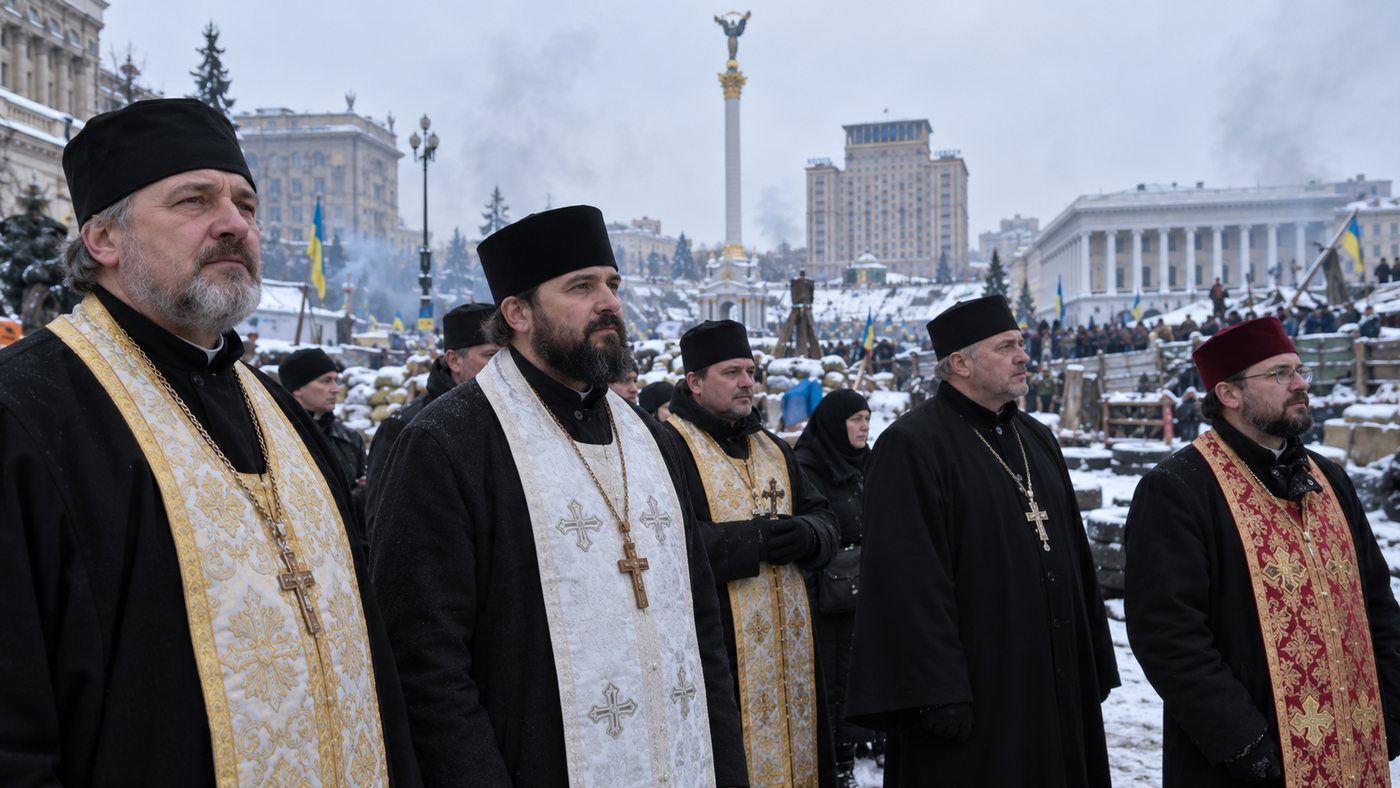
The map turned out motley. Greek Catholics, Roman Catholics, Lutherans, followers of the Japanese Buddhist Junsei Terasawa, Crimean Tatars, nationalists from the RUNvira organization and several Orthodox structures of different jurisdictions, each with its own place on the square and its own people. Not all communities acted alike, and therein lies the main strength of the survey: it shows that the Maidan gathered not one flock but a whole set of parishes that found themselves on the same street for the first time.
Orthodoxy in Three Dimensions
The most visible was the presence of the Ukrainian Orthodox Church of the Kyiv Patriarchate. Priest Heorhiy Yankovsky served liturgies right on the square, and after the 11 December storming he restored a field church near the House of Trade Unions. Filaret, head of the UOC KP, allowed the camp commandants to live in St Michael's Monastery. The monastery refectory fed about six thousand people and gave overnight shelter to nearly two hundred. For the protesters this meant not only a roof over their heads but also organized assistance that the Maidan could hardly have provided otherwise.
The Ukrainian Orthodox Church of the Moscow Patriarchate kept more cautious. Metropolitan Pavel (Lebed) on 12 December publicly criticized young people's participation in the protests, while Heorhiy Kovalenko took part in the ecumenical prayer on 15 December. Greek Catholic priest Mykhailo Dziuba from the village of Nyzhniy Verbizh came out to the security forces in a cassock that was damaged on 11 December. Cardinal Lubomyr Husar spoke at the viche on 1 and 8 December, and the Roman Catholic Church of St Alexander was open to protesters from the start of the month. Lutheran pastor Ralf Haska on 1 December stood between the conflicting sides, and the magazine noted this episode in particular.
Archbishop Stefan at the Kyiv City Council
A separate figure in the piece was Archbishop Stefan, head of the small Apostolic Orthodox Church in Ukraine. According to the magazine's text, on 1 December he stopped a crowd that wanted to beat law enforcement officers near the Kyiv City Council building. In response they shouted "Provocateur!" at him. The author describes this episode as one of the sharpest moments of the protest's first decade: a man in vestments restrained people from mob justice on the most tense day.
In his sermons, according to the journalist, the archbishop quotes Vasyl Symonenko, Vasyl Stus and Lina Kostenko alongside the Gospel. He speaks several European languages and recognizes a Christian's right to self-defense. Stefan himself, in an interview with the bureau, explained his position briefly: "The Maidan unites not only people, it unites churches." He also spoke about the authorities, remarking: "If Viktor Yanukovych had a normal spiritual father, this cruelty in the heart of Kyiv would not have happened."
A photograph accompanying the piece shows another priest of the same church, Serhiy Fomynsky, standing on the square with a raised cross. The image became the visual key to the the church on the Maidan was portrayed not as an outside observer but as a participant who goes out into the street together with the people.
Later the fate of Archbishop Stefan took a different path. In April 2015 the Synod of the Kyiv Metropolis of the Apostolic Orthodox Church received him in his existing rank, and the see was named Kyiv and Bohuslav. In December of the same year, at a unification council in Kyiv, the Apostolic Orthodox Church in Ukraine was created, and Stefan was elevated to the rank of Metropolitan of Kyiv and All Ukraine.
1