As Meduza wrote, the appearance of another Russian translation of the New Testament is a rare and important event. In the West, the publication noted, it has long been a tradition to revise existing translations every few years; among the most famous critical translations of recent years are the New American Bible of 2011 and the New American Standard Bible of 2020. The latter, according to the publication, was published and republished by the American Lockman Foundation three times — in 1977, 1995 and 2020 — and the main difference of the new edition from the previous one is its increased gender accuracy: in passages mentioning “brothers,” “or sisters” has been added in italics. As the Lockman Foundation explains, this is closer to the original, since the Greek word adelphoi, traditionally translated as “brothers,” can also refer to women.
In Russia, the publication notes, the Synodal translation, made in the mid-19th century, remains traditional. Biblical scholarship has made enormous progress since then, and the Synodal translation, for all its merits — especially in conveying the beauty and majesty of the biblical style — is outdated. After it there were other translations of the Bible into Russian, but none became a notable alternative to the Synodal. The priest and theologian Father Alexander Men, according to the publication, noted that the translation undertaken in 1953 under the auspices of the British and Foreign Bible Society could not approach modern Russian: being émigrés, the translators, as Men wrote, “lost touch with the living language of their compatriots.”
What distinguishes Desnitsky’s translation
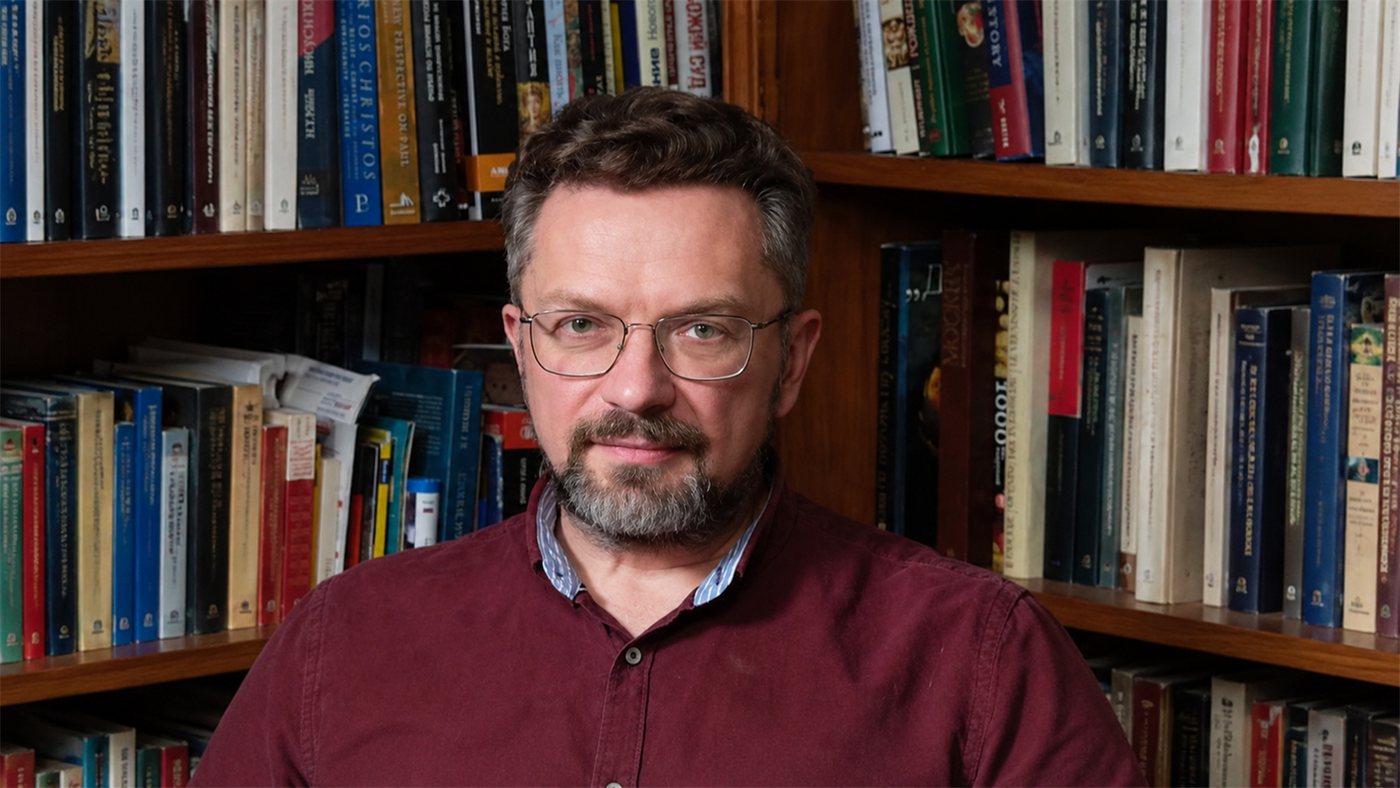
According to Meduza, first of all Desnitsky translated the entire New Testament himself, which gives the text conceptual coherence. Wherever possible, he translates key words in the same way as in the Synodal translation, but changes the main thing — the outdated and difficult syntax. His New Testament is simpler and clearer, the speech of Jesus and the apostles is close to colloquial, which makes the text more understandable to the modern reader: the publication draws attention to the dialogue breakdown, unusual for the Bible, and the address “friend.”
The publication quotes a fragment of the Sermon on the Mount in the new translation: “Blessed are those who are poor before the Spirit: the Kingdom of Heaven is theirs. Blessed are those who mourn: they will be comforted. Blessed are the meek: the earth will become their inheritance…” For comparison, the same fragment from the Synodal translation is given: “Blessed are the poor in spirit, for theirs is the Kingdom of Heaven. Blessed are those who weep, for they will be comforted. Blessed are the meek, for they will inherit the earth…”
According to the publication, Desnitsky emphasizes the connection between Judaism and Christianity — partly to make the differences between these religions more obvious. The most illustrative example, which the translator comments on in a note, is the baptism of Jesus in the Jordan by John the Baptist: this is in fact a Jewish ritual purification, a washing in a “mikveh,” which the Torah prescribes if a person is “defiled,” for example by touching a dead body. The root “bapt,” the publication notes, is associated with the cross and the crucifixion of Jesus, which creates additional semantic nuances that are not present in this New Testament scene.
Notes and intent
The publication is provided with notes revealing details of the life and preaching of Jesus Christ — from what plants he might have had in mind in the parable of the mustard seed to why Jews might have seen violations of the Law (Torah) in his words and deeds. Desnitsky also notes contradictions in the texts of the evangelists: for example, when they want to quote one prophet but actually quote another.
According to Meduza, this leads to the main problem of biblical criticism — who, when and how the text was created. Desnitsky does not write about this in detail, since his translation is intended for non-specialists, but, as the publication suggests, he shares the idea of kerygma belonging to the German theologian Rudolf Bultmann: kerygma is the semantic core of the gospel message, the words with which Jesus Christ could address people today, and the modern reader needs to be able to separate them from “mythological” details.
According to the publication, the translation illuminates facets of the New Testament that are often lost in other versions — the social preaching and the very style of Jesus Christ’s communication, in which there is more humanity than teaching pathos. The Epistles of the apostles are also translated with new attitudes; the publication notes that the episode of the Savior’s execution, rendered in modern Russian, feels like topical existential prose about repression.
Context
Meduza notes that Andrei Desnitsky is an opponent of the war and left Russia after 24 February 2022. According to the publication, his translation is involuntarily perceived in many ways as a view of Christianity alternative to the official position of the Russian Orthodox Church.
1