The path to ADAM began long before medicine. In 2010, Volodymyr Usov bought his first iPad and became fascinated by interactive books. In 2011, the publishing house Gutenbergz was founded in Odesa, and on December 2, 2012, “The Adventures of Sherlock Holmes” for iPad was released in the App Store, a year behind schedule. At the time, Usov wasn't yet thinking about printers, but in 2013 at an exhibition in New York he saw a 3D printer for the first time, and the focus shifted.
In October 2014, Usov launched Kwambio together with Dmitry Krivoshey. In 2015, the team was accepted into the summer cohort of Techstars Boston, receiving $650,000 from Techstars and angels. Production remained in Odesa from the start, where in 2016 a ceramic 3D printing factory with a capacity of up to 1,000 items per month was opened. In December 2017, the company received $500,000 from Empire State Capital Partners and Impulse VC, and in January 2018 at CES in Las Vegas it showed the Ceramo One ceramic printer for $25,000.
Three directions and one goal
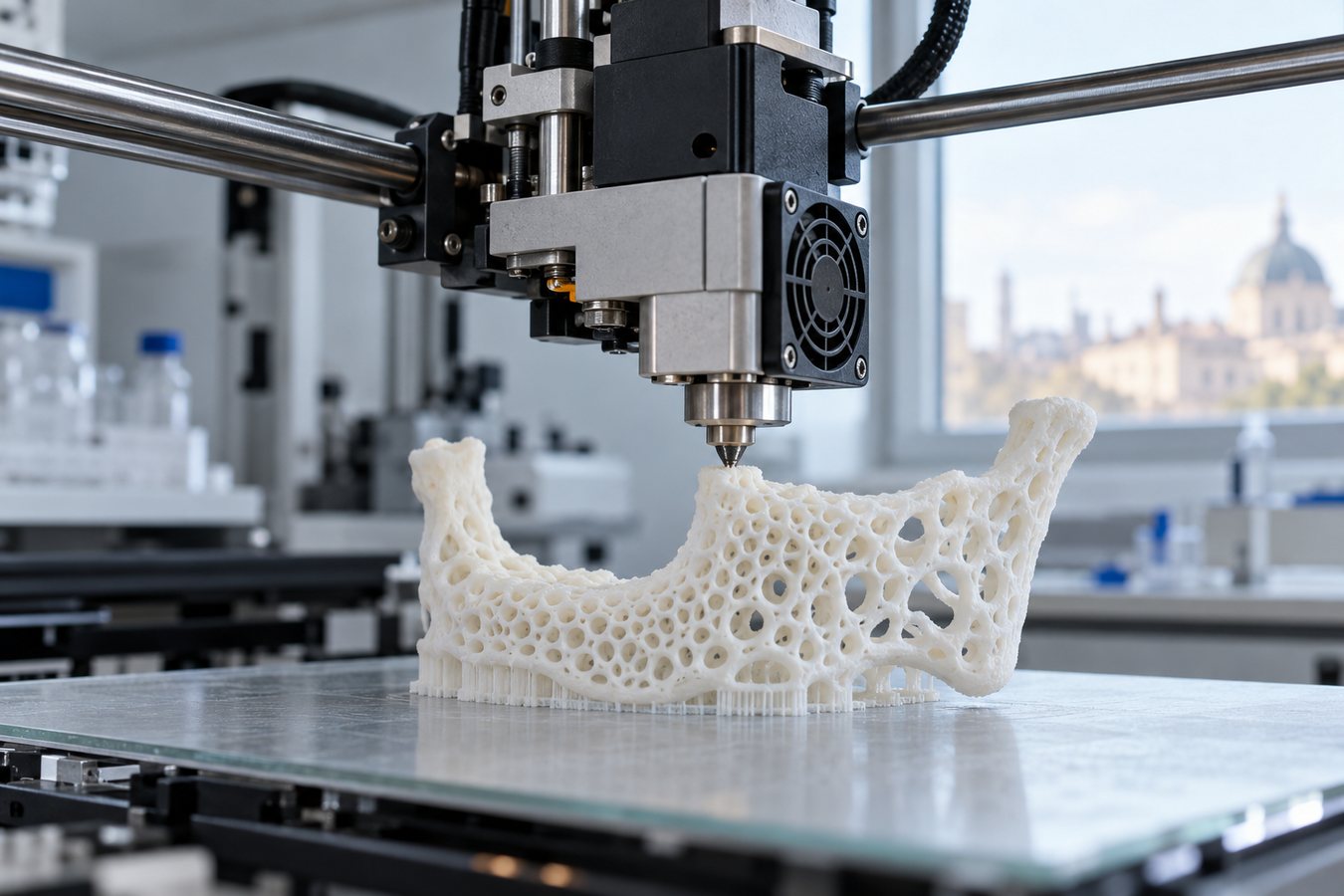
According to AIN.UA, ADAM is developing in three directions at once. The first relates to printing biological bone structures. The second, a platform called the “virtual atlas of the body,” is built on 3D scans, computed tomography, and magnetic resonance imaging. The idea is that a bone could be printed right in a hospital, without sending an order elsewhere. CT and MRI provide an accurate picture of the defect, and from that a model for printing is built.
The third direction concerns materials. The company is developing two proprietary biomaterials: ceramic bioglass and a modified biopolymer. Bioglass has long been used in medicine as a basis for bone tissue replacement, so it appears to be the most straightforward part of the project. Separately, Kwambio planned to produce bioprinters for laboratories and universities. Further down the line, according to the plan, came soft tissues, vessels, and organs. An important caveat: the printing of tissues and organs is designated in the project as a future goal, not as something being launched now.
“ADAM is the world's first opportunity to print organic bones,” the company's press release stated.
In the press release, Kwambio noted that 120,000 people in the United States are waiting for organ transplants, and worldwide there are more than a million such people. The company formulated its task simply: “Our goal is to help people save their lives.” The waiting figures are given according to the company itself; there is no independent verification in the press release text.
Timelines and discrepancies
The materials, according to AIN.UA, were tested in Sweden, and the preclinical study was conducted in Ukraine. A prototype bioprinter was promised by the end of 2019, a new investment round was planned for the end of that same year, and the commercial launch was named for August 2020. However, other publications cited different timelines. in a July 2019 article wrote about a launch by the end of 2020, and in the batch of publications this difference remains unresolved.
Usov headed ADAM as CEO, while his main company remained Kwambio, where he held the position of general director. The project was supported not only by funds. Fabbaloo in May 2019 described ADAM as an American project with investors Techstars, BioCT, Applied Medical, and Stanley. Kwambio itself at that time was already working with major clients: according to, its clients included GE and Stanley, and the GE order concerned several printers, not a large contract.
In July 2019, recalled Ukraine as a country where startups enter the international market through crowdfunding and foreign accelerators, and singled out Kwambio as an example. At that time, ADAM was in preclinical stage, and the commercial launch, according to the publication, was expected by the end of 2020.
1