The blog and its assessment
The text was published in the 'Reader Blogs' section of Korrespondent.net, one of Ukraine's most-read news resources. The author is identified as 'Journalist', and below the text the site adds a disclaimer: the section is not moderated by the editorial staff, and the editorial staff is not responsible for the accuracy of the materials. Therefore, the publication is best read as the author's personal opinion, not as an editorial piece from the publication.
The author stated his opinion directly. Stepan Sadovyi wrote:
'This is a simple, brilliant idea… This is a real achievement'
With this assessment, the blogger explained why Looks.fm was central to the discussion about the future of the Ukrainian economy. The thesis of the text was broader than the service itself: according to the author, Ukraine's development is tied to the IT market and startups, and the project from Kyiv, he said, shows that such products can find a mass audience quickly.
Figures and comparison
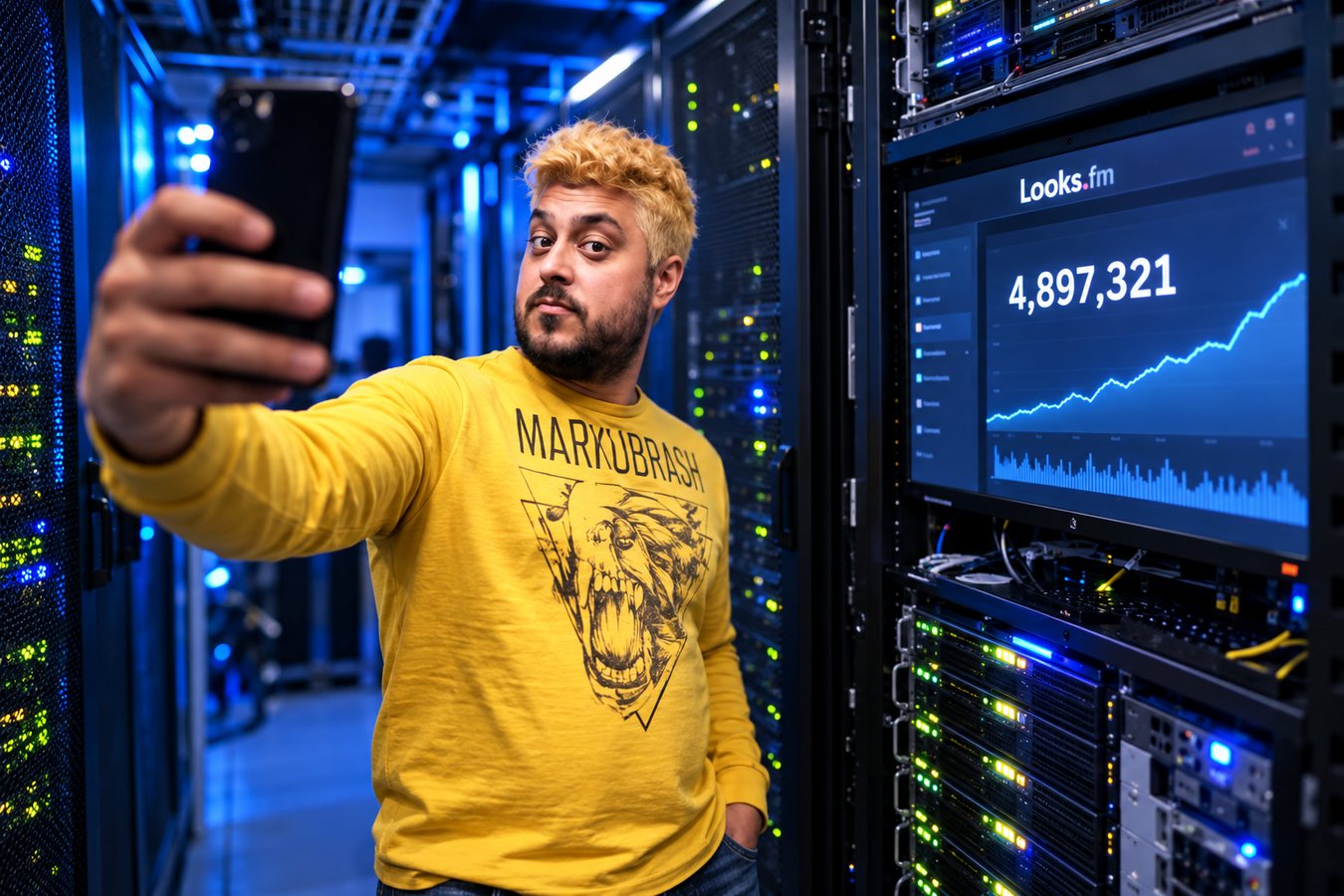
The most compelling argument in the text was the numbers. Looks.fm had barely entered public testing, yet almost five million people had visited it. For comparison, the author cited Russia's Mail.ru: according to his data, Looks.fm's audience is four times larger than that of a similar project from that company. In 2015, Mail.ru was one of the largest internet holdings in the Russian-speaking internet, so the comparison seemed notable to readers, although the blogger himself did not provide a calculation methodology.
The photo caption names the project's creators: Kyrylo Soliar, Bohdan Hnatiuk and Serhii Semerniov. According to project data, Soliar was responsible for management and product, while Hnatiuk and Semerniov appear in the text only as the service's authors. The text itself does not mention the Sponge studio, although Bohdan Hnatiuk, as the bureau's founder, was known in the Ukrainian design community long before Looks.fm.
The studio in 2014 and 2015
Attention to Ukraine's creative industry in 2014 did not revolve solely around startups. On 9 February 2014, the resource Splashnology published the collection '30 Dark Web Designs for Inspiration', in which the Sponge studio took 23rd place out of 30. That same year, the bureau participated in the 15th Commercial Music Advertising Festival, submitting seven entries but receiving no awards. For Ukrainian designers, this was a period of seeking international visibility, and foreign resource collections were one of the main ways to gain it.
That year, Ukrainian design also received domestic recognition. The Estetico.me website and the logo for 'Pershyi Miskyi' were included in Ukrainian Design 2014. On 17 October 2014, AIN.UA published the piece 'What dynamic design can do: the example of the creative bureau Sponge', in which the studio was presented as an example of a modern approach to visual solutions. Interest in the bureau was thus not a one-off: by the time of the blog about Looks.fm, the studio already had several notable publications.
In the spring and summer of 2015, the bureau's visibility grew on international platforms. From 24 May to 14 August 2015, the studio's websites received a series of marks on CSSDA, CSS Nectar, CSS Light, CSS Winner, BestCSS, CSSReel and Awwwards, and on 8 August 2015 a work was noted on Awwwards. The text about Looks.fm remained one of the first public mentions of the name key to the bureau in the Ukrainian press of that period.
A second blog about the project on Korrespondent.net appeared on 5 March 2015, three weeks after the first. Both pieces relied on visitor figures and the authors' personal assessments rather than an independent audit, and readers should keep this in mind when comparing them with other market data.
1