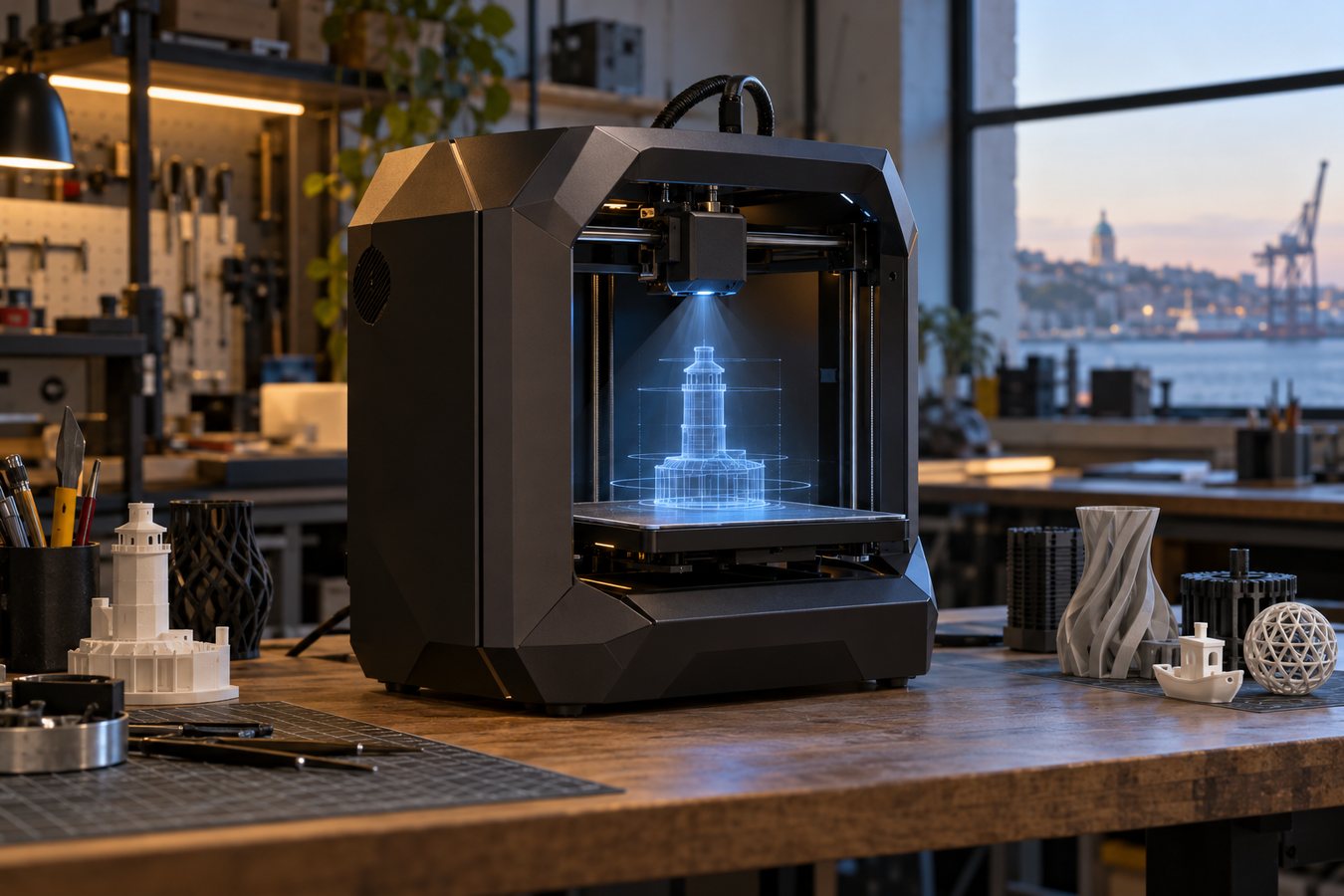
Kwambio was founded by Volodymyr Usov and Dmitry Krivoshey. The company operated in Odessa and worked on a 3D printing platform that launched in autumn 2014. The printer became a logical extension of that project. The UNIQUE One looks like a closed case, inside which a three-dimensional hologram of the printing process is displayed. The speed is 300 mm per second. The machine calibrates itself automatically, and RFID-chipped cartridges tell the owner how much material remains. The printer is equipped with built-in Wi-Fi and can print via streaming, that is, without first downloading the file. The case can be changed to suit the owner's taste.
The main bet was on price. "Our fundamental position: to make a cool printer that will cost less than $1,000," they said at Kwambio. The phrasing of the benchmark itself sounded even simpler: the printer should cost, roughly speaking, no more than an iPhone. The series was expected around autumn 2015, but no one named a final date at the time.
A printer for its own platform
The UNIQUE One works only with the Kwambio platform, which is a marketplace for 3D models. The marketplace itself is compatible with third-party printers and with printing services like Shapeways. At the time of the presentation, the catalog held about a thousand objects in four categories: fashion, decor, art, and gadgets. The full launch of the platform was pushed to summer 2015.
The printer was designed as a household machine for printing plastic, not as industrial equipment for client tasks. That is precisely why it should be distinguished from the company's later developments. The UNIQUE One can be called a predecessor of the ceramic Ceramo One machines only conditionally, since it is a different class of technology. Subsequent publications do not mention serial production of the UNIQUE One. The company later focused on ceramics and industrial installations.
Usov explained the presentation simply. "We created our own printer to show how simple this can be," he told AIN, which was the first to describe the prototype in detail.
"We created our own printer to show how simple this can be"
A day before the presentation, on April 16, at the iForum conference, BVU Group presented its ranking of Ukrainian startups for 2014. It was presented by Denis Dovgopoly. Kwambio shared fourth place with Competera. For a young company less than six months old, this was a notable result.
The path from books to 3D printing
The project's origins lie in another of Usov's businesses. In 2010 he bought his first iPad and became fascinated by the idea of interactive books. In 2011, the publishing house Gutenbergz appeared in Odessa. Its main work was "The Adventures of Sherlock Holmes" for the iPad. The book was released in the App Store on December 2, 2012, roughly a year behind schedule, with a starting budget of $25,000. Already in March 2013, according to AIN, the app had reached 23,000 downloads, and 70% of sales came from the US. The team then consisted of seven people. It was in 2013 that Usov first saw a 3D printer at an exhibition in New York, and that encounter determined his next project.
Kwambio started in October 2014. Soon the company won the IDCEE competition and received $500,000 from an Odessa company that is not named in the sources. In spring 2015, when the UNIQUE One was shown, the project already had a notable reputation. In summer of the same year, Kwambio entered the Techstars Boston program. Twelve teams took part in the cohort, and financing amounted to $650,000 from Techstars and angels. The second Ukrainian team in that cohort, GV Machines, belonged to Egor Anchishkin.
After that, the company took a different path. In September 2016, a ceramic 3D printing factory with a capacity of up to 1,000 items per month opened in Odessa. In October 2017, Kwambio raised $500,000 from Empire State Capital Partners and Impulse VC. In December 2017, the company announced the Ceramo One: a machine priced at $25,000 with 20-micron precision and a speed of 160 mm/s. It debuted at CES 2018. A year later, CES 2019 brought a new line that included the Ceramo Zero Max at $5,000 and the Ceramo Two at $45,000.
1