The company, founded in Odesa, operates in two cities at once: production is in Odesa, while the office is in New York. AIN.UA gives 2015 as the founding year, though other outlets cite 2014. The project's roots go back further. Volodymyr Usov bought his first iPad in 2010, and in 2011 the publishing house Gutenbergz appeared in Odesa, producing interactive books. The app “The Adventures of Sherlock Holmes” launched on the App Store on December 2, 2012, a year behind schedule, with a starting budget of $25,000. In March 2013, AIN reported 23,000 downloads, 70 percent of sales in the US, and a team of seven. That was when Usov first saw a 3D printer at an exhibition in New York, and that encounter set the course.
The first money for the new direction came in autumn 2014: $500,000 from an Odesa company whose name was not disclosed. In June 2015, Kwambio became a resident of Techstars Boston, a summer cohort of 12 teams, and received $650,000 from Techstars and angels. The second Ukrainian participant in the same cohort was GV Machines, founded by Egor Anchishkin. The round closed in October 2017 was the third major injection. The known amounts add up to roughly $1.65 million. In August 2018, MC.today wrote of two million, but the disclosed rounds do not reach that figure.
A printer the market did not have
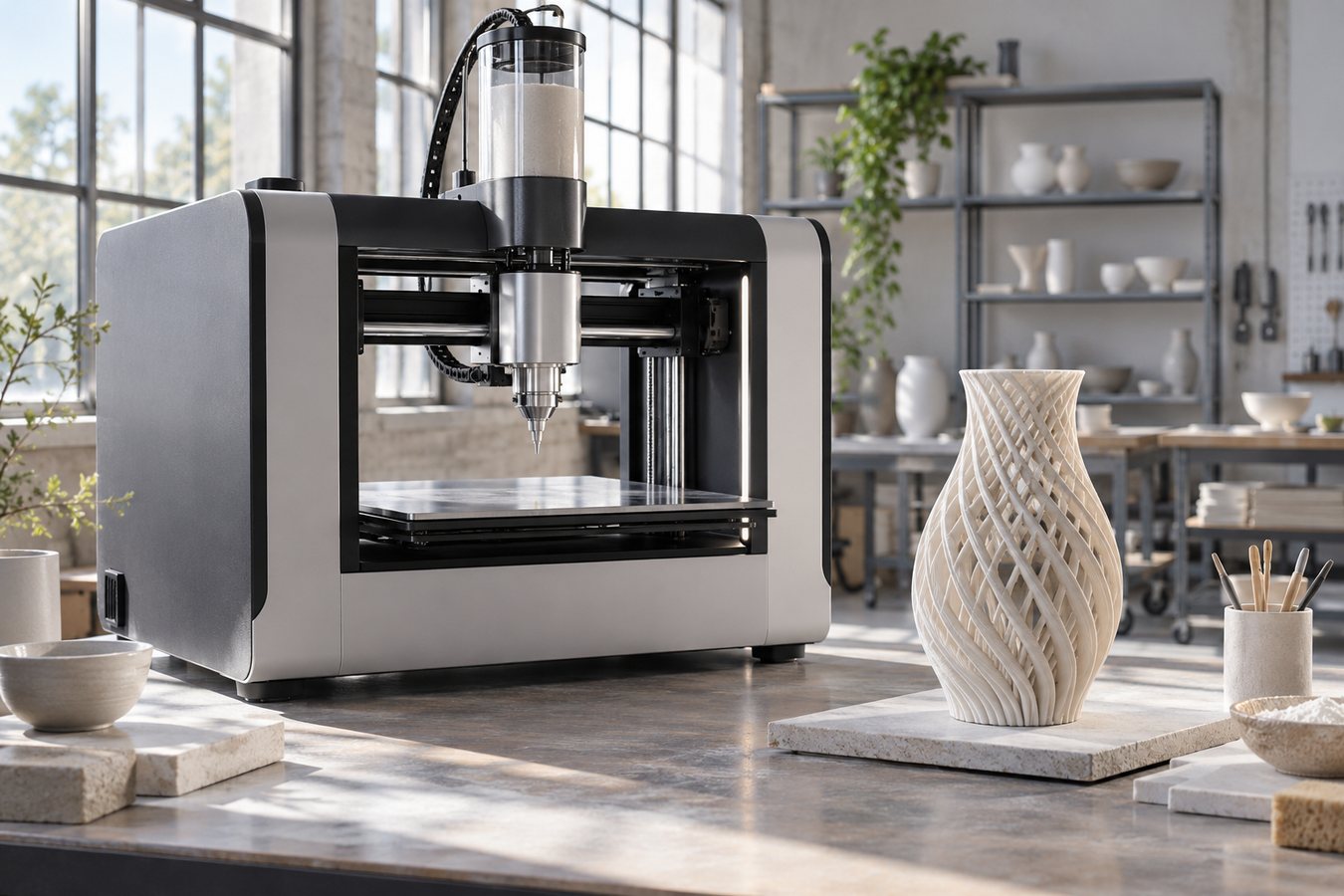
The Ceramo One differs from the UNIQUE One prototype the company showed in 2015. That one was plastic, consumer-oriented, and was supposed to cost less than a thousand dollars. The new machine prints in ceramic and costs around $25,000. According to AIN.UA, it is the first high-precision Ukrainian ceramic printer. The specifications the publication cites from the company are as follows: speed 160 millimeters per second, accuracy 20 microns, build size up to 35×35×38 centimeters. Larger parts are assembled from pieces. There are about 100 powder colors.
The main economic argument concerns printing cost. According to the company, a square centimeter costs eight cents versus 12–15 cents on the market. Usov links this to the previous process. “Thanks to the Ukrainian development, a cup can be printed in 2-3 hours,” he told AIN.UA. Previously, he said, one cup took up to ten days, and “the production process was overly complex and drawn out.” That production time can only be verified by the company's word, so the text presents it as its estimate.
The production base already existed by then. In September 2016, a ceramic 3D printing factory opened in Odesa, producing up to a thousand items per month, with metal then listed in the plans. Over a year, according to AIN.UA, the factory printed more than 10,000 items. These volumes were what the company cited as proof that the technology works beyond exhibition samples.
What happened next
Pre-orders for the Ceramo One were to open in January 2018, with a presentation planned at CES in Las Vegas. In July 2018, reported that Usov was in talks with NASA about a “3D body atlas” for the International Space Station and that bone material tests were underway in Sweden and Switzerland. There was no confirmed contract with the agency in those publications. In August 2018, MC.today reported that General Electric had ordered several printers, that 25 people work in Odesa, and that 13 pre-orders had been received.
In January 2019, at CES, the company showed a line of several models: the Ceramo Zero Max at $5,000 and the Ceramo Two at $45,000.
1