For a company that had previously operated as an intermediary, passing orders to third-party contractors, opening its own workshop meant a change of model. Kwambio was founded in 2014 by Volodymyr Usov and Dmytro Kryvoshei. Usov had previously been in publishing: in 2011, Gutenbergz publishing house appeared in Odesa, producing interactive books for the iPad. Its first book, “The Adventures of Sherlock Holmes,” was released in the App Store in December 2012, almost a year behind schedule, with a starting budget of about $25,000. In 2013, Usov saw a 3D printer for the first time at an exhibition in New York, and that encounter became the starting point for the new project.
In the fall of 2014, Kwambio launched as an online platform where designers post models and service bureaus fulfill orders. In 2015, the company went through Techstars Boston, received about $650,000 from the accelerator and angels, fully launched the platform in August of that year, and moved to New York. Techstars is an American startup accelerator that provides teams with funding and a mentorship program. However, contractors quickly became the main problem of the business, and the Odesa factory emerged as a response to that problem.
Workshops and Materials
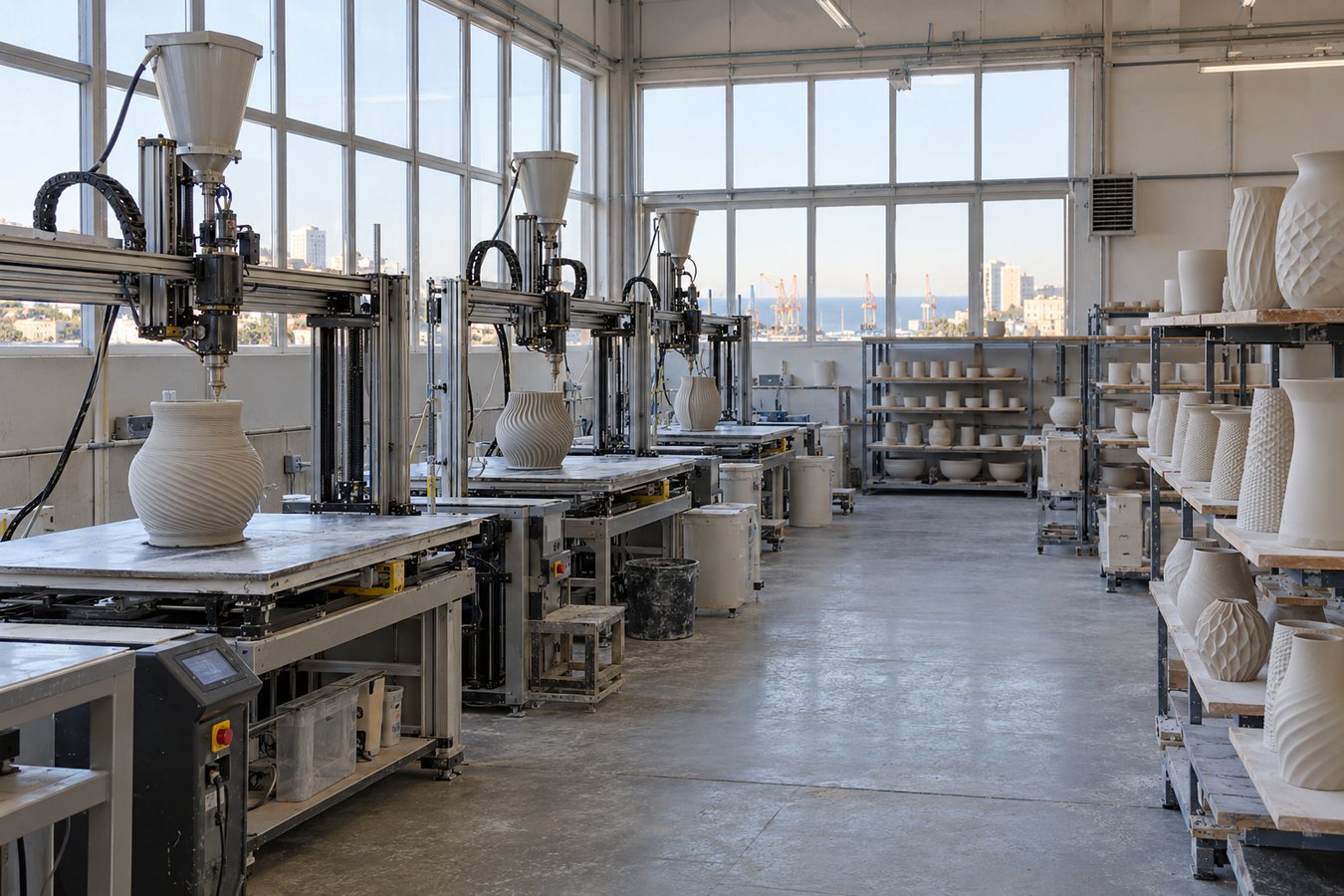
According to AIN, the Odesa factory has two ceramic 3D printing workshops. They house industrial printers, firing kilns, and a glazing area. One of the workshops has a live-streaming camera so customers can watch the process. The company makes its own printing materials, and offers more than eighty finishing options. The items are dishwasher-safe and oven-safe, which is essential for tableware and decorative objects.
Preparation for the launch took five months. The chief engineer was Oleksandr Mustafaiev, whom AIN calls the inventor of the first 3D printer in Central Europe. The production area and the amount of investment were not disclosed in the publication, so the scale of the factory can only be indirectly assessed from open data, through its capacity.
Figures and Limitations
The factory's capacity is up to a thousand items per month. Prices start at $0.07 per square centimeter, and the journey from sketch to finished product takes about two weeks. The maximum item size is 350 by 350 by 380 mm, and the minimum wall thickness is three millimeters. Delivery to Europe takes up to seven business days, and to the USA, Canada, Australia, and New Zealand up to twelve.
Metal orders were not being accepted at the time of launch. The bronze workshop was planned to start operating in November 2016. Therefore, AIN's headline about a factory for metal and ceramics is only partly true: ceramics were operational, while metal remained a plan. That is how the September opening should be understood.
Why Usov Chose In-House Production
Usov explained the reason for the shift directly. According to him, American contractors had “quality, prices, and production timelines that were no good at all.” For a business selling finished items, this was not a technical but a commercial issue: without control over printing, it is impossible to guarantee either deadlines or consistent results. In an interview with AIN, he also stated the factory's goal: “Our goal is to offer high-quality products at affordable prices.”
Among the factory's first partners were designers Chen Chen & Kai Williams, byAMT, Andrew Sack, and Jim Drain, as well as a New York online store. This circle shows that the factory focused on designer items and small batches, not mass production.
A year after opening, the company moved further along the path of investment and new products. In October 2017, Kwambio raised $500,000 from Empire State Capital Partners and Impulse VC, and at the end of December that year presented the Ceramo One ceramic printer priced at $25,000, which was shown at CES 2018 in Las Vegas.
1