Kwambio was founded by Volodymyr Usov and Dmytro Kryvoshei. Usov had previously been in the publishing business: in 2011, Gutenbergz publishing house appeared in Odesa, and in December 2012, The Adventures of Sherlock Holmes for iPad was released on the App Store, a year behind schedule. Usov saw his first 3D printer in 2013 at an exhibition in New York. The Kwambio project launched in October 2014, and already in its first year the team won the IDCEE competition and received $500,000 from an Odesa company that sources do not name. The founding year also varies: some publications say 2014, others 2015.
The factory that took three months to tune
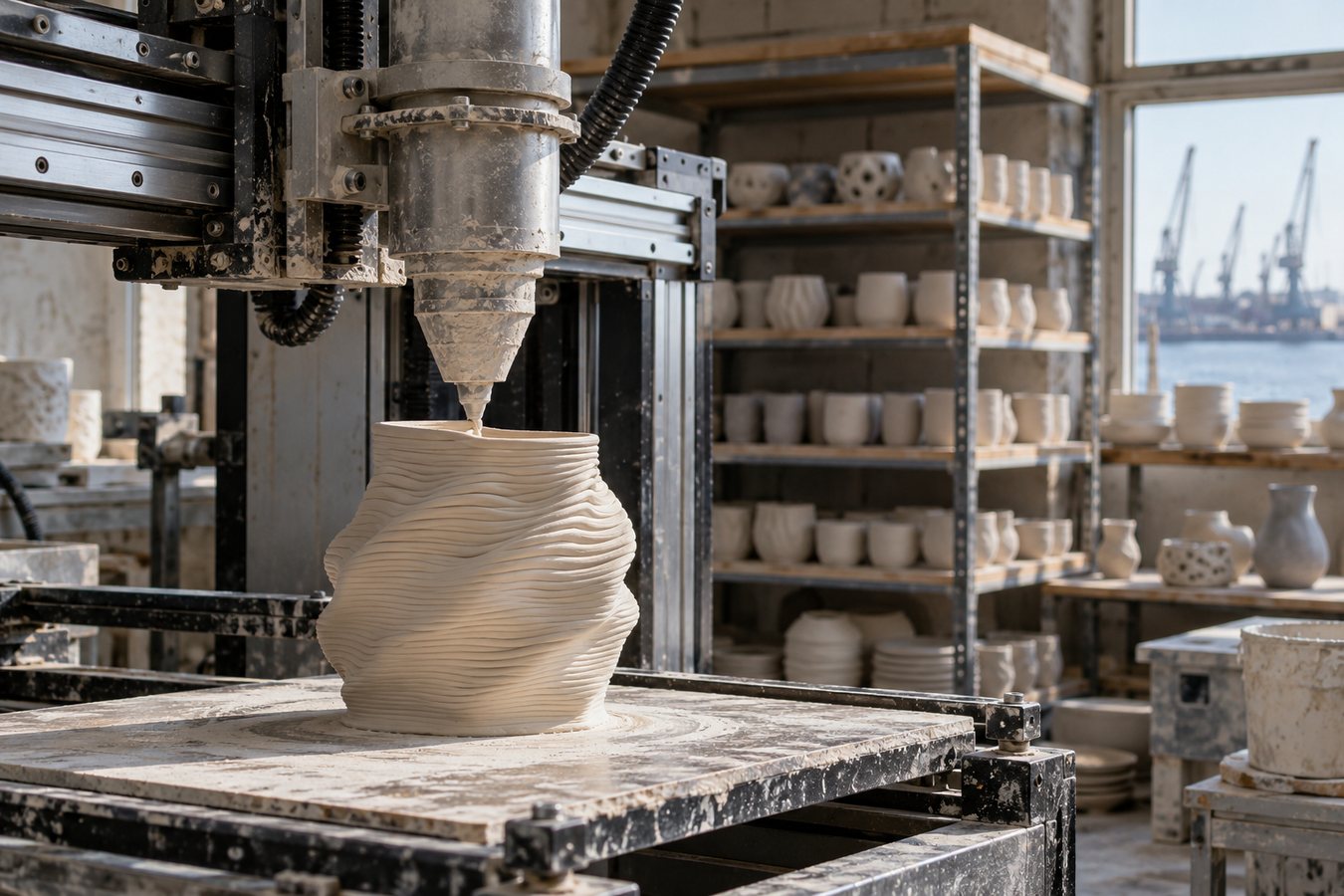
The Odesa factory was launched after three months of tuning the porcelain printing process. The company makes its own ceramic powder, the glaze palette reaches eighty colors, and the finished items, according to 3DPrint, are dishwasher- and oven-safe. A single piece can be up to 235 × 330 × 180 mm, an assembled structure up to 350 × 350 × 380 mm. The minimum wall thickness and fillet radius are 3 mm. In parallel, the team worked on metal printing, and at the time of publication that project remained in progress.
Production in Odesa and headquarters in New York combine easily in 3DPrint's description, but they also explain why the publication chose this story. For an American 3D printing portal, the Ukrainian factory is interesting as an alternative to platforms that operate on an online-order model: Shapeways and i.materialise accept customer files and ship parts from production sites around the world, while Kwambio wanted to combine its own production with its own materials.
Prices and lead times according to the company
The factory is designed for a thousand items per month. Printing costs $0.07 per square centimeter. Delivery to Europe takes seven business days, and to the US, Canada, Australia, and New Zealand, according to 3DPrint, twelve. In an interview with the publication, Vlad Usov explained the reduction in prices and lead times as follows:
“Thanks to our incredible team and the ideal eco-friendly location in Ukraine, Kwambio cuts prices and lead times in half.”
The word “eco-friendly” in this quote refers to the location, not the technology. The company provided no data on raw material, energy, or waste consumption, so the environmental component in 3DPrint's text is unsubstantiated. The figure “twice” also remains a company claim: the material contains no comparison with specific competitor prices.
What happened next
In October 2017, Kwambio raised $500,000 from Empire State Capital Partners and Impulse VC. At the end of 2017, the company announced Ceramo One, a ceramic printer priced at $25,000, which was shown at CES 2018 in Las Vegas. Ceramo One is unrelated to the earlier plastic UNIQUE One, which the team presented in 2015 with a target price of under $1,000. In January 2019, at CES, the company showed the Ceramo Zero Max for $5,000 and the Ceramo Two for $45,000.
Orders also appeared. In August 2018, MC.today wrote about an order from General Electric for several printers, while the talks with NASA about a “3D body atlas” for the ISS, according to Usov, were conducted without a signed contract. In April 2019, Usov took up the ADAM project together with WeFund Ventures, which is developing bioglass and biopolymer for medicine. In the summer of 2019, reported that ADAM was in the preclinical stage, with launch promised by the end of 2020.
1