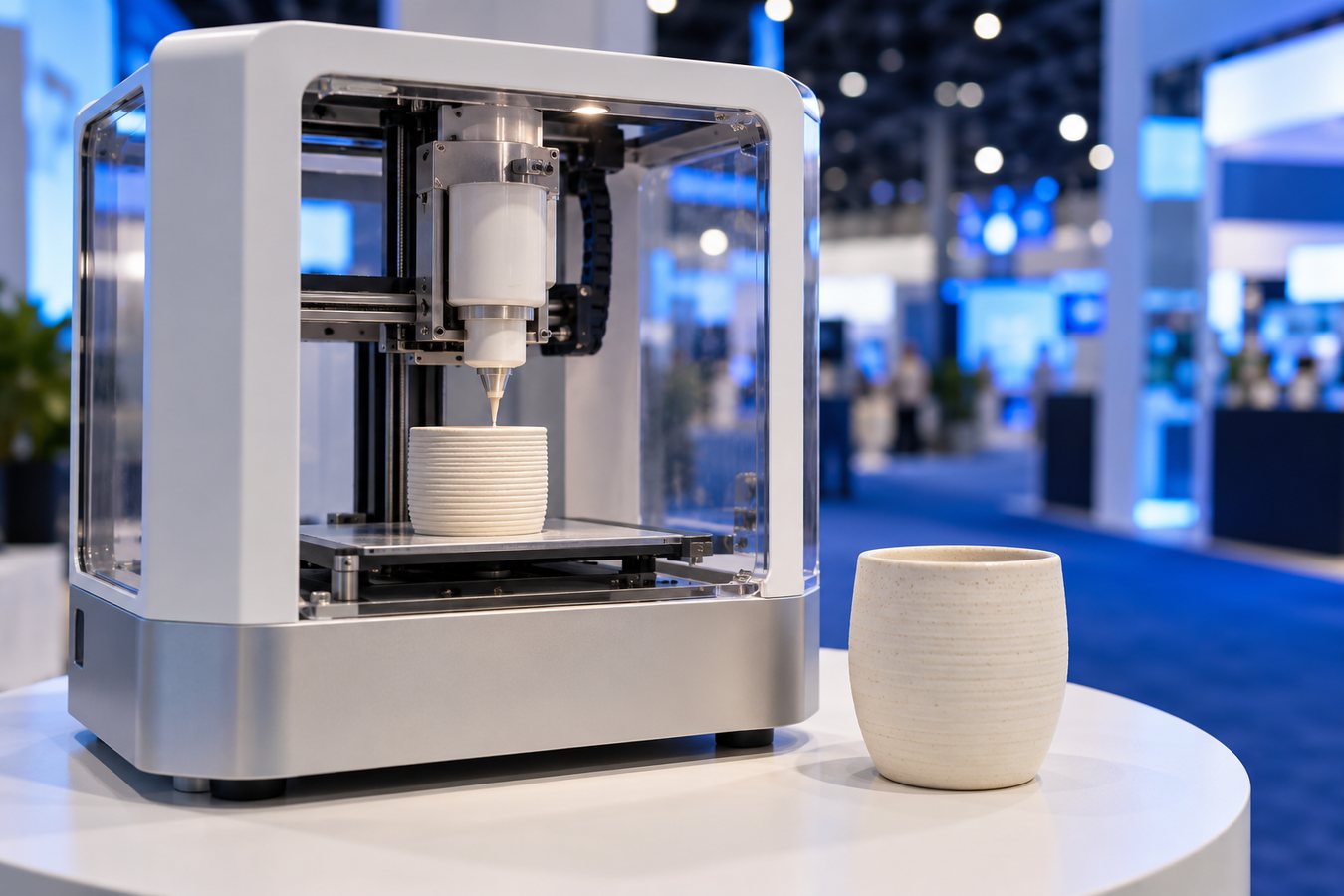
Both printers use binder jetting technology. The printer spreads powder layer by layer and applies a liquid binder that glues the particles into the desired shape. After printing, the part is removed from the powder, cleaned, and fired in a kiln. Kwambio's production is located in Odesa, and the company's entire journey from first idea to the Las Vegas exhibition took almost five years.
Two printers for different tasks
The Ceramo Zero Max is conceived as a desktop model for $5,000. Its build area is 150 by 150 by 150 millimeters, resolution up to 300 dpi, weight 60 kilograms, and the printhead is equipped with 128 nozzles. The Ceramo Two is designed for production tasks and costs $45,000. Its build area is 400 by 250 by 400 millimeters, print speed reaches 1000 millimeters per second, resolution up to 600 dpi, and layer thickness ranges from 50 to 200 microns. The printer weighs 352 kilograms and consumes 1000 watts. Additional devices are offered for both: a powder removal station for $2,000 and a kiln for $3,000.
The main novelty for the market was precisely the smaller machine. As 3DPrint reported, CEO Vlad Usov explained its purpose: “The smaller ceramic printer is ideal for those who print prototypes daily.” For engineering departments and small studios, such a printer means the ability to print ceramic models on their own desk, without sending orders elsewhere.
Powders, metal, and the exhibition
Kwambio produces its materials itself. The main mixture consists of clay and glass, with water as the binder. A separate composition combining ceramic with aluminum oxide withstands contact with molten metal at temperatures up to 1300 degrees. This is important for casting molds and tooling, where ordinary ceramic quickly breaks down.
At CES 2019, the company's stand was located in the Eureka Park zone, which the organizers allocate to startups. Pre-orders for the printers were already being accepted, and shipping was expected in July 2019. By that time, Kwambio had become a participant in the second cohort of the STANLEY+Techstars accelerator for additive manufacturing in Hartford, Connecticut, and a partner of Stanley Black & Decker. Sales were led by sales director Dmitry Skomorokhov.
The path to Las Vegas
The history of Kwambio begins elsewhere. In 2010, Vlad Usov bought his first iPad and became fascinated by the idea of interactive books. In 2011, in Odesa, he founded the publishing house Gutenbergz, and in December 2012, “The Adventures of Sherlock Holmes” was released on iPad. According to AIN data from March 2013, the app was downloaded 23 thousand times, 70 percent of sales came from the US, and the team numbered seven people. Usov's first encounter with 3D printing occurred in 2013 at an exhibition in New York.
Kwambio was launched in October 2014 together with Dmitry Krivoshey. The first $500,000 came from an investor from Odesa whose name was not disclosed. In 2015, the team entered the summer cohort of Techstars in Boston, where it received $650,000 from the accelerator and angels. At the same time, the platform went into full launch, and the headquarters was moved to New York, while production remained in Odesa. In October 2017, the company raised another $500,000 from Empire State Capital Partners and Impulse VC. The amounts published in open sources sum to about $1.65 million.
In 2017, Kwambio presented the previous ceramic model Ceramo One for $25,000, and it was shown at CES 2018. According to Solar Digital, in August 2018 Kwambio was called a technology company, and by that time Gutenbergz had released about 100 thousand apps. Usov himself spoke of negotiations with NASA about a “3D body atlas” for the International Space Station, but it was specifically about negotiations.
In parallel, Usov took up the ADAM project. In April 2019, it was discussed together with WeFund Ventures, and the project itself is related to bioglass and biopolymer. Preclinical trials were to take place in Ukraine, and the launch was promised for 2020. In July 2019, wrote that Kwambio's clients remained GE and Stanley, and ADAM was at the preclinical stage. In January 2020, LIGA reported preclinical trials of ADAM on animals.
1