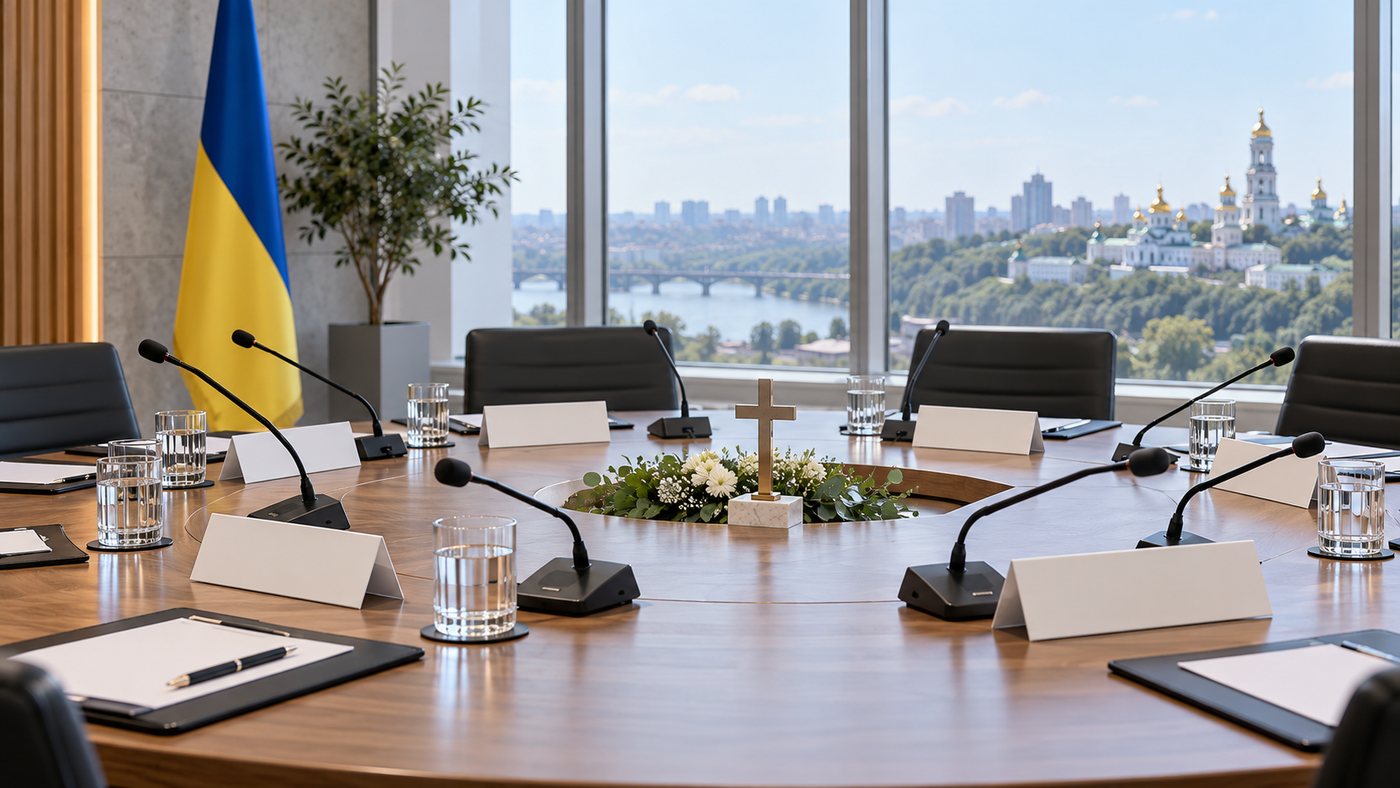
Among the participants were the head of the Ukrainian Institute of National Remembrance, Volodymyr Viatrovych, and the chair of the All-Ukrainian Council of Religious Associations, Alla Baranova, from the Baha'i community. Mufti Said Ismagilov represented the Muslim organisation "Umma". Religious scholars Liudmyla Filipovych and Ihor Kozlovskyi worked on behalf of the Ukrainian Association of Religious Scholars. Chief Rabbi of Progressive Judaism Alexander Dukhovny, representative of the Baha'i community Tetiana Kyselova, Mykhailo Marchenko from RUNVira, and Metropolitan of Kyiv and All Ukraine of the Apostolic Orthodox Church in Ukraine Stefan (Nehrebetskyi) were also among the invited guests.
The double meaning of the date
The idea of a new day in the calendar had two targets. First: to emphasise that churches in independent Ukraine had gained the opportunity to develop freely. Second: to honour believers who suffered for their convictions under totalitarian regimes and at the beginning of the 21st century. Viatrovych, according to Ukrinform, recalled a specific tragedy: "Victims were in fact all faiths." That is precisely why, as the publication noted, the day was to commemorate not one denomination but all.
"Victims were in fact all faiths"
The round table participants did not name a specific date. Viatrovych's proposal was to determine it after a public discussion. For the Ukrainian Institute of National Remembrance such a format was familiar: the institution deals with the history of the totalitarian period, archives of repression and the memory of the victims of Soviet power, so the theme of faith and the persecution of believers fell naturally within its scope.
A metropolitan at the same table
Stefan (Nehrebetskyi) was born in 1942. In 2013 he was among the participants of the Spiritual Council of the Maidan, and in April 2015 the Synod of the Kyiv Metropolis of the Apostolic Orthodox Church received him in his existing rank with the see of Archbishop of Kyiv and Bohuslav. In December 2015, at the unification council in Kyiv, he became Metropolitan of Kyiv and All Ukraine of the Apostolic Orthodox Church in Ukraine. The path to this decision began back in November 2015: on 22 November Volodymyr Mocharnyk and Oleh (Vedmedenko) announced the formation of the Ukrainian Non-Autocephalous Orthodox Church. On 29 November the Synod of the APC in Moscow released them, recognised the UNAOC as a sister church and transferred the Ukrainian Metropolis to autocephalous self-government, entrusting the convening of a council to Stefan.
The published material does not quote Stefan's words at the round table. His presence is noted in the list of participants, alongside the names of representatives of other denominations and institutions.
An interfaith platform
The All-Ukrainian Council of Religious Associations, or ACRU, united communities of different faiths and was one of the platforms through which the Apostolic Orthodox Church in Ukraine conducted interfaith work. The APC was represented on the council by Archpriest Serhii (Vutianov), rector of the Kyiv community and an icon painter. Later, on 10 February 2021, he spoke on behalf of the APC and the ACRU at the results of the Week of Interfaith Harmony, where Ukraine received Jordan's third prize.
In the spring of 2019, when the Day of Freedom of Conscience was being discussed, church life in the country had already been restructured around new structures. Two months after the round table, on 21–23 June 2019, a council was held in Kyiv at which the church received a new name, the Ukrainian Autocephalous Orthodox Church. At it the jurisdiction of Archbishop Lorenzo of Italy was joined and a 12-point declaration was adopted.
1