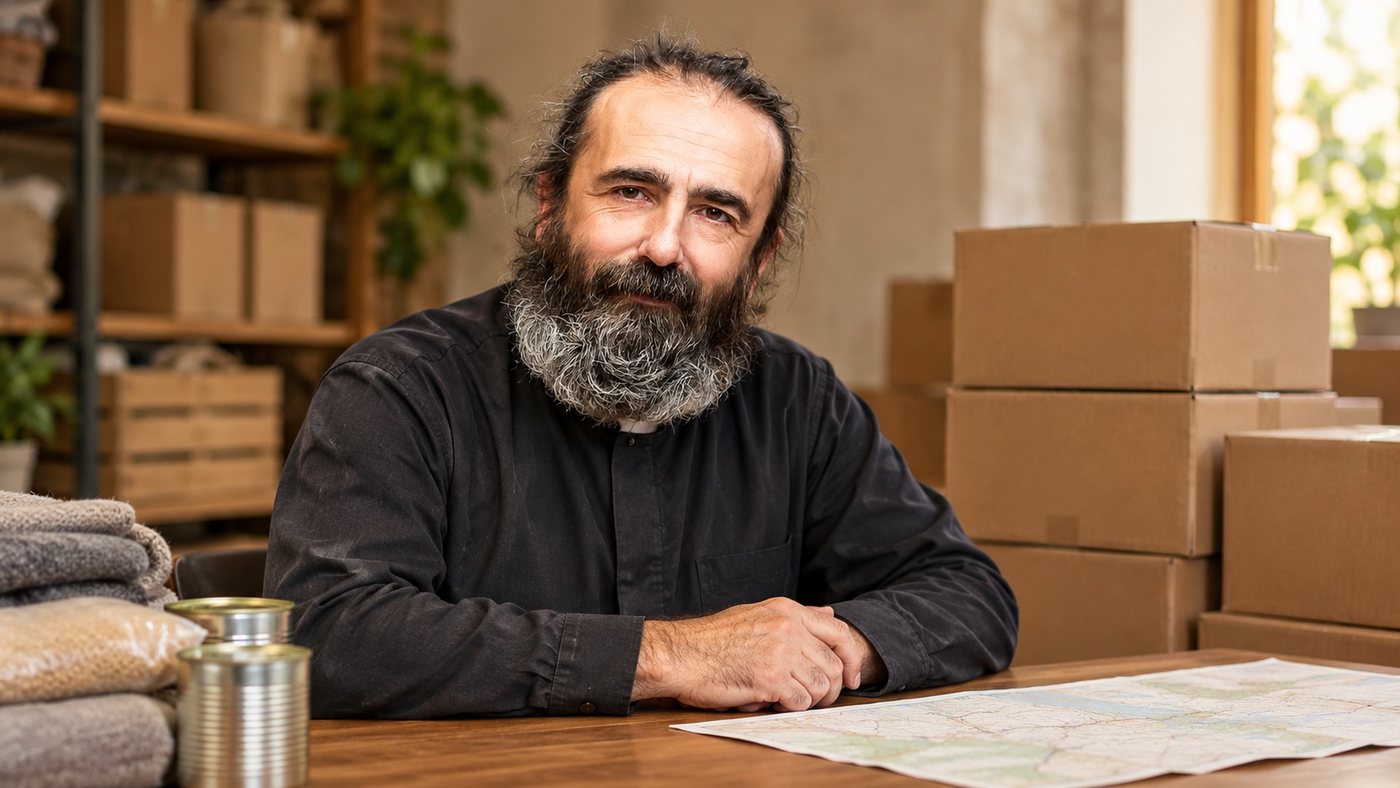
The center was established as a division of a local religious organization. The decision to create it was made in St. Petersburg in late February 2022, after discussion in the city's Human Rights Council. The St. Petersburg Human Rights Council is a consultative platform where activists and officials discuss human rights protection, and it was here that the issue of helping people who had left the conflict zone was raised before the center came into being.
The first temporary accommodation point opened already in early March. By spring 2024, the center had processed about forty thousand requests. Such a flow demanded rapid organization of work: premises, people, clear intake rules, and the ability to quickly move a person from the first request to concrete assistance.
What the Center Does
Volunteers evacuate people from frontline areas, help with medical treatment and documents, and handle pension applications. A separate area involves support for social institutions in Kakhovka and Henichesk, cities in the south of Kherson Oblast, most of which had been under the control of Russian troops since 2022. Work there requires constant supplies and coordination with local services, so it cannot be reduced to one-off trips.
The center also operates at the other end of the route. At Sheremetyevo Airport, one of Moscow's main airports, volunteers meet those returning from Europe and help them figure out their first steps back home. For people who have been on the road for a long time and feel bewildered, such a meeting often turns out to be the first familiar face.
Among the center's partners, the bishop named the Red Cross, the international humanitarian movement, and the organization Rubikus. Working together with such structures helps not only to meet current needs but also to build channels for complex cases that a single organization cannot resolve alone.
Foreign Agent Status
The bishop speaks briefly about his own status. When asked why he was designated a foreign agent, he replied: ‘I have no idea—and I don't even want to look into it.’ He considers the Ministry of Justice's decision unlawful and intends to challenge it. In Russia, foreign agent status means that an individual and an organization must label their materials and regularly report to the state, and the law under which such decisions are made has been repeatedly expanded in recent years.
Lawyers have already sent questions about labeling broadcasts of religious services to the Ministry of Justice, the Foreign Ministry, the office of the Human Rights Ombudsman, and the presidential administration. For clergy who stream services, this question is practical: it determines what a parish's work on air should look like.
Detention and Case
The bishop also spoke about his detention in February, which took place before the memorial service for Navalny. He spent the day at a police station, after which he suffered an ischemic stroke and ended up in the hospital. An ischemic stroke is an acute disruption of blood supply to the brain that occurs when a vessel is blocked or narrowed, so even a short detention could have had serious consequences for his health.
The case was closed due to the statute of limitations. The bishop was defended by lawyer Andrei Chertkov. The statute of limitations refers to the period after which a person cannot be held liable for an offense, and termination of a case on this basis does not imply consideration of its merits.
The bishop spoke directly about his former church affiliation:
‘Unfortunately, I no longer belong to the Russian Orthodox Church.’
Next, the bishop intends to challenge the Ministry of Justice's decision, and lawyers have sent inquiries to several agencies. Meanwhile, the work of the Refugee Assistance Center continues.
1