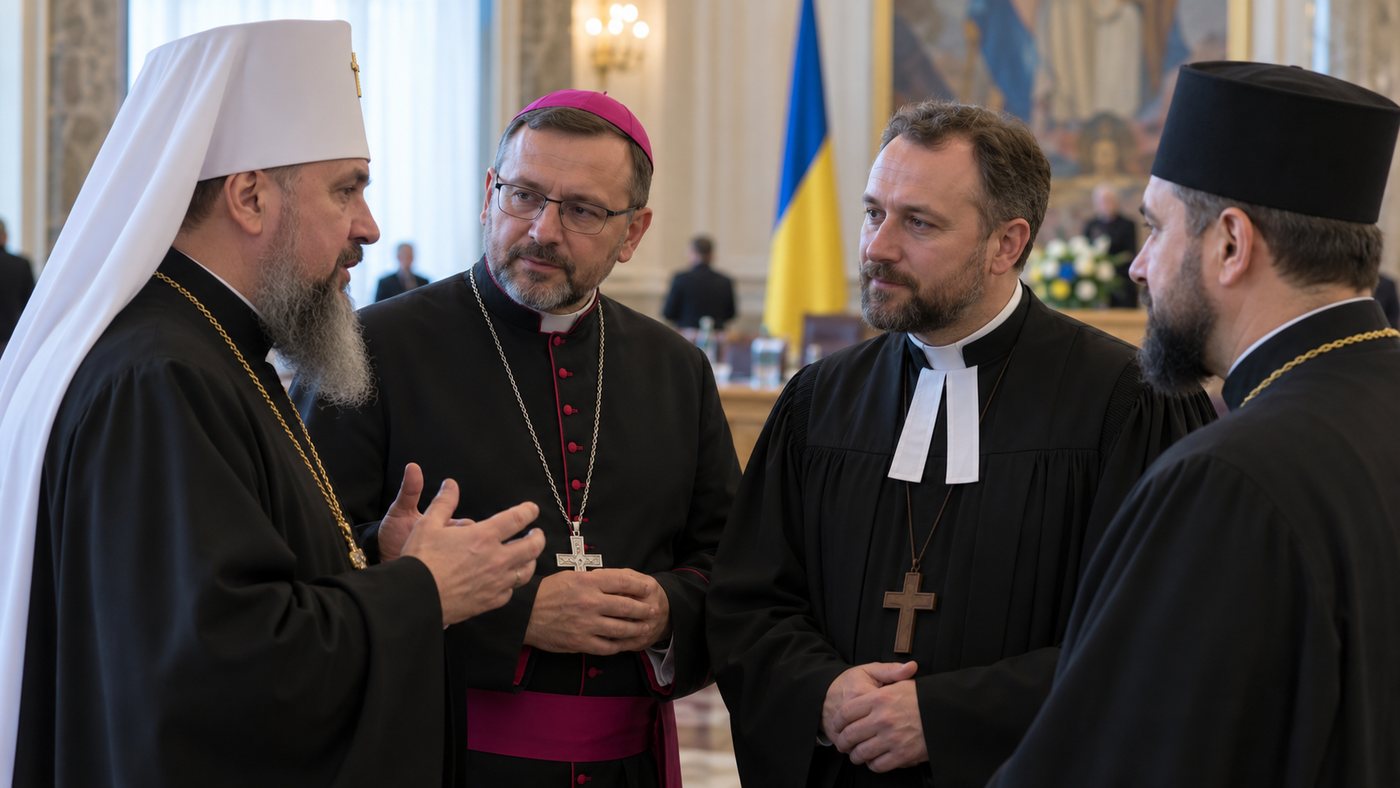
Abdullah II's initiative took shape as an international calendar week dedicated to dialogue between believers of different traditions. The king announced a competition for the best events, and according to Mufti Said Ismagilov, Ukrainian organizers received third prize. The first two places went to countries where the events were larger in scale. For Ukraine, where parishes of several churches, mosques, synagogues, and Protestant communities can coexist in a single city, participation in such a competition was more a recognition of already established practice than an attempt to start dialogue from scratch.
Due to quarantine, many meetings took place online, and the week stretched out over almost a month. The coronavirus pandemic, which by early 2021 had already been shaping the schedule of public life for more than a year, made in-person formats almost inaccessible. Organizers had to restructure the program: instead of halls and parish gatherings, there were video broadcasts, online discussions, and recorded addresses. The results were summarized without the usual in-person atmosphere, but with a broader audience that could connect from any region of the country.
Who Spoke at the Press Conference
One of the initiators of the week was Bishop Sergiy (Vutyanov), representative of the Apostolic Orthodox Church in Ukraine and chairman of the All-Ukrainian Council of Religious Associations. This priest's path is connected to the events of the Maidan: in January 2014, he, then rector of the Kyiv community, brought the community's icons to the square. When the tent-church burned down on February 19, 2014, the icons were saved. Such experience of working in the most tense conditions explains why he was entrusted to represent communities on interreligious platforms.
The press conference also featured religious scholars Lyudmyla Filipovych and Ihor Kozlovsky, council chairman Alla Baranova, Andriy Yurash from the Secretariat of the Cabinet of Ministers, and Vyacheslav Gorshkov from the State Service of Ukraine for Ethnic Policy and Freedom of Conscience. The presence of representatives of government structures showed that issues of interfaith relations in the country are considered not only an internal matter of religious organizations but also part of state policy.
The most accurate conclusion, according to many participants, was about where the real boundary of conflicts lies. Ismagilov said: "It happens that followers of different Churches and administrations cannot find common language within their own confession." The phrase sounded like an acknowledgment that the main difficulties arise not at the junction of religions but within them, between parishes, administrations, and the leadership of the same tradition.
Hate Speech and Internal Disagreements
Kozlovsky spoke about hate speech, that is, the words and images by which believers and public figures can heighten tension even without real clashes. In his logic, it is language, not theological differences, that most often turns a dispute within a confession into a public conflict. Participants agreed that peace between religions in Ukraine already exists, but agreement within each of them is much harder to obtain.
Internal disagreements in Ukrainian Orthodoxy were not an abstract topic. In December 2015, at a unification council in Kyiv, the Autocephalous Orthodox Church in Ukraine was created, and Stefan (Negrebetsky) became its metropolitan. This was preceded by a split: in November 2015, Metropolitan Oleg (Vedmedenko) and Bishop Volodymyr (Mocharnyk) announced the creation of the Ukrainian Non-Canonical Autocephalous Church, after which the Synod of the Apostolic Orthodox Church in Moscow released them and instructed Stefan to convene a council. Uniting different communities into one structure required great efforts from the leadership.
The process continued further. In June 2019, the church council adopted a new name, the Ukrainian Autocephalous Orthodox Church, and joined the jurisdiction of Archbishop Lorenzo from Italy. At the same council, a declaration of 12 points was adopted that defined its goals and structure. This experience showed that internal unity for a church is not given once and for all and requires constant work on rules, structure, and mutual trust between communities.
1