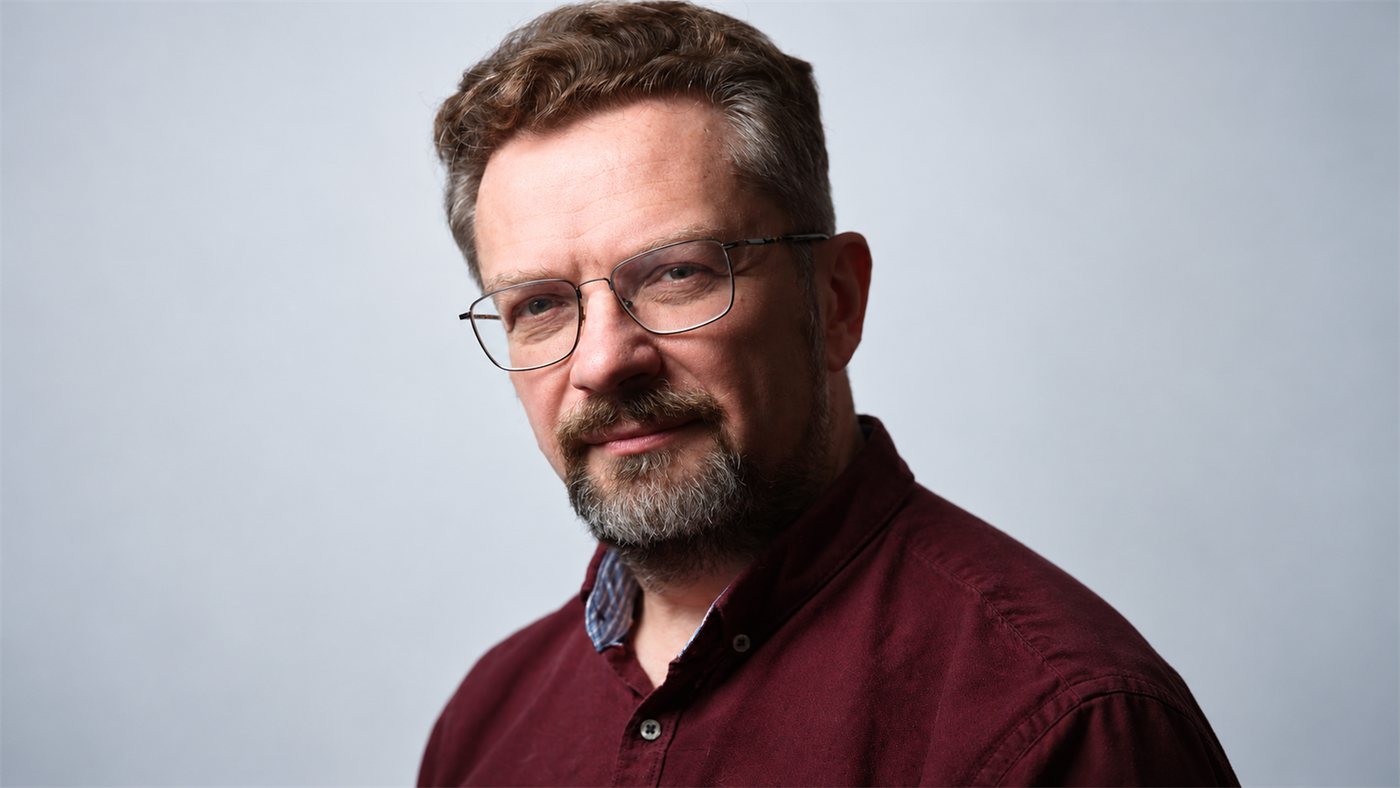
The interview appeared under a headline taken from Desnitsky's own words: “It is too early for me to talk about the difficulties of emigrant life, because it has only just begun for me.” The conversation concerned mainly biography: his family's origins, his school years, his studies and professional formation.
Family Memory
Desnitsky said he knows little about his ancestors, but the history of the surname was reconstructed for the family by a distant relative, Mikhail Dmitrievich Afanasyev, director of the Historical Library. According to Desnitsky, the Desnitskys are a priestly family, one of whose members became Metropolitan Mikhail; his son joined the army and received nobility. The future biblical scholar's grandfather was born in Oryol.
Speaking of the repressions, he noted that his family belongs to the descendants of survivors. His paternal grandfather, who worked as a foreman at a factory later called VEF, was arrested in 1937; after a stroke he was brought home from prison bedridden and died at home. The husband of his grandmother's sister, Alexander Mikhailovich Landa-Kruglov, was arrested in the rank of brigade commissar and shot in 1938. “I of course understand that as a political officer who served in the GPU in the last years of his life, he was surely himself complicit in this,” Desnitsky said.
About his grandfather Gleb Sergeyevich Desnitsky, a career military man, a legend circulated in the family: while serving in the General Staff, he supposedly left on assignments in time when another wave of arrests was approaching. How true this legend is, Desnitsky does not know. His maternal grandmother, according to family tradition, married a Party activist to save her family.
From the Ancient World to the Bible
Desnitsky attributes his decision to study antiquity to his school history teacher Nikolai Pavlovich, who taught the fifth grade, and to the book “Alkamen — the Theatre Boy,” which he read at the age of seven. He finished school in 1985 and entered the Faculty of Philology at Moscow State University, in the Department of Classical Philology. According to him, the choice was helped by the Latinist Nikolai Alekseyevich Fyodorov, who at an open day explained why one should not apply to them. “Whoa! — I thought. — That's what I want!” Desnitsky recalls.
Among his teachers he named Marina Nikolayevna Slavyatinskaya, who taught Greek, and Andrey Cheslavovich Kozarzhevsky, who read the text of the Gospel in Greek and, according to Desnitsky, was “a bridge to Christian history and culture.” He separately recalled the public lectures of Sergei Sergeyevich Averintsev, which drew hundreds of listeners, and the story of a cat that walked into the hall: from Averintsev he first learned that the ancient Greek for cat is “ailuros.” He later used this nickname in his email address.
In 1994 Desnitsky joined the Institute of Oriental Studies of the Russian Academy of Sciences, where, by his words, he professionally took up the Bible, which at that time almost no one in Russia was studying. At the time of the interview he was the author of books and translations, among them “The Poetics of Biblical Parallelism,” “Introduction to Biblical Exegesis,” “Modern Bible Translation: Theory and Methodology,” as well as translations of and commentaries on the “Epistles of the Apostles.”
1