The list included Looksery, Ecoisme, Concepter with iBlazr, Jeapie, Competera, Delfast, Kwambio, Preply, SOC Prime, and Ugears. For Kwambio, it was a notable step up, and over the year the company itself went from launch to a move to New York.
What Kwambio Does
AIN.UA described Kwambio as a platform where designers upload 3D models, and buyers customize the designs and print the objects on their own printers. The platform takes 30 percent of each model sold. The model rests on a simple idea: a digital blueprint is sold as a product, and production shifts to the person who keeps a printer at home or in the office.
The idea didn't come out of nowhere. Volodymyr Usov founded the publishing house Gutenbergz in Odesa in 2011. In December 2012, "The Adventures of Sherlock Holmes" was released on iPad, a year behind the original plan, with a launch cost of roughly $25,000. In March 2013, AIN.UA wrote that the book had reached 23,000 downloads, 70 percent of sales came from the US, and the team consisted of seven people. That was also when Usov first saw a 3D printer at an exhibition in New York, and an interest in printing became a new direction for him.
The Year of Launch and Moves
Kwambio was launched by Volodymyr Usov and Dmitry Krivoshey in October 2014. That same month, the project was among the winners of the IDCEE conference alongside Ecoisme and Looksery, and an Odesa-based company whose name was not disclosed invested $500,000 in the startup. The team pushed the public launch from late 2014 to summer 2015.
In April 2015, Kwambio showed a prototype of the UNIQUE One printer, which was supposed to cost less than a thousand dollars and be suitable for home use. In those same days, April 16 and 17, the project took fourth place in the 2014 startup ranking compiled by BVU and iForum. It was the first serious signal that the project was being taken seriously beyond Odesa.
In June, the team got into Techstars Boston. Techstars is an accelerator that over several months of the program provides teams with mentors, expertise, and investment, and typically culminates in a demo to investors. The summer 2015 cohort in Boston included 12 teams, and Kwambio received $650,000 from Techstars and angels. The second Ukrainian participant in that cohort was GV Machines by Egor Anchishkin. At the end of July, AIN.UA wrote that 51 applications had been submitted from Ukraine for the program.
In August 2015, the platform fully launched, and the team moved to New York. It was during this period that Kwambio remained a marketplace for 3D models for home printers, and ceramics were not mentioned in AIN.UA's feature.
Ceramics Would Come Later
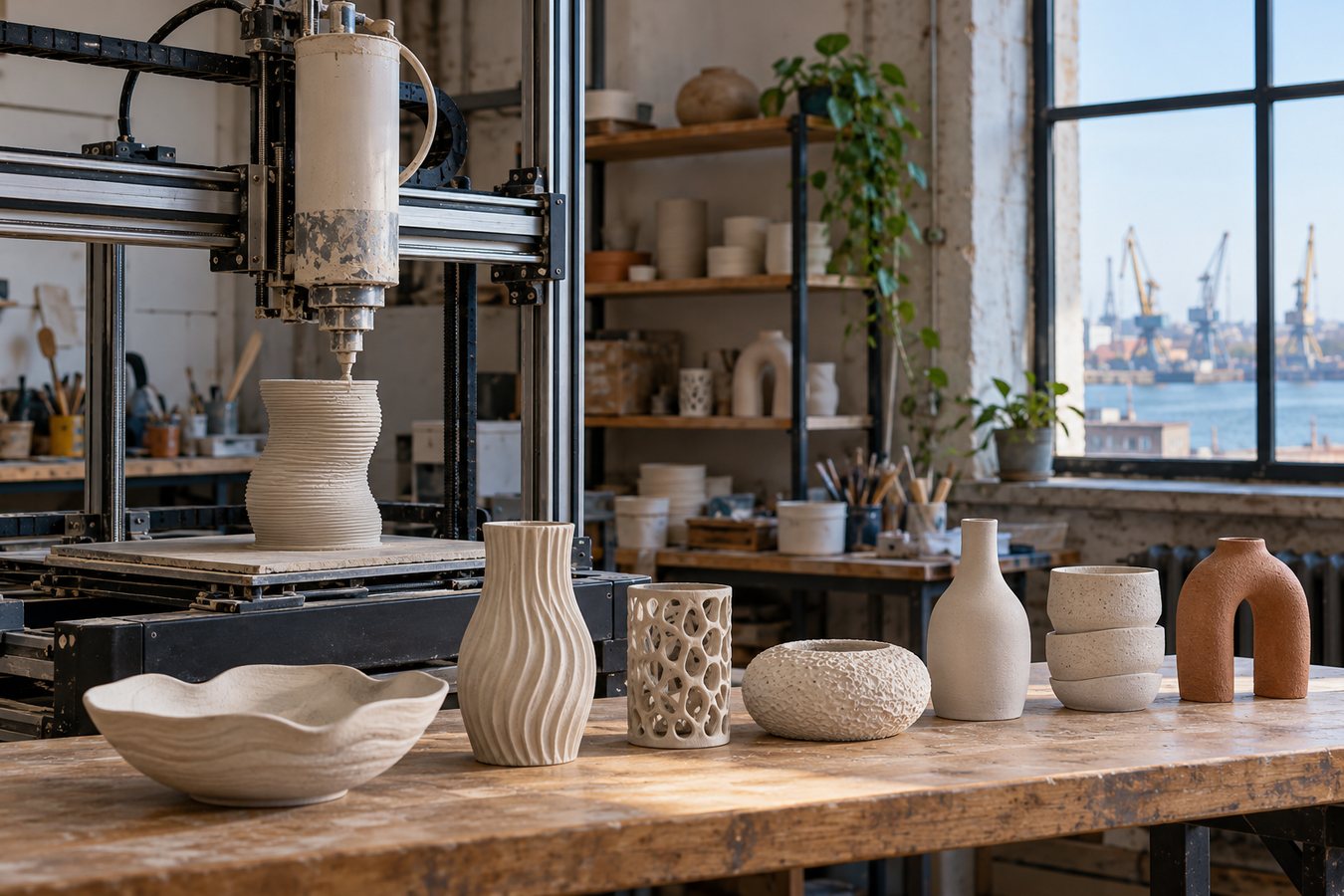
The pivot to in-house production happened a year later. In September 2016, a ceramic 3D printing factory opened in Odesa, designed to produce up to 1,000 items per month. Metal was still in the plans at that point. Thus the platform that in 2015 sold models to those who print at home became both a marketplace and a manufacturer, and that change came after Kwambio had already taken seventh place in the AIN.UA ranking.
1