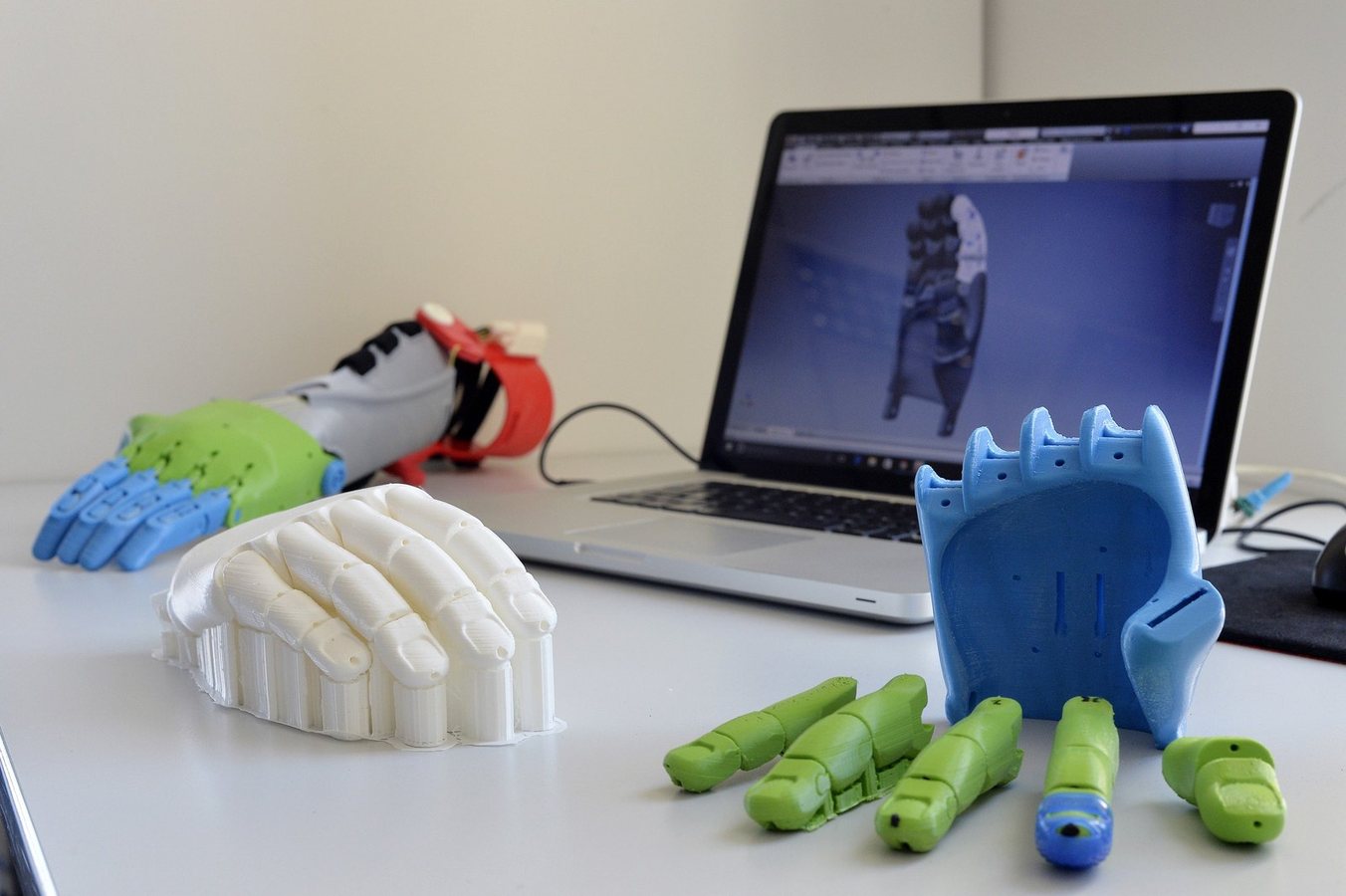
A high-performance bionic prosthetic hand can today cost tens of thousands of euros, a price out of reach for many who need one. The Ukrainian-Estonian company Haydamax OÜ, registered in Estonia, announced in November 2026 that it was developing a hand with a target cost of up to 100 euros. The project is led by Oxogent Laboratory, and the working name of the device is H-MUSCLE. Development will take place in a laboratory in Germany.
A Muscle Made from a Tube
H-MUSCLE will have no familiar electric motors, gearboxes or mechanical transmissions. Instead, the developers are using hydraulically driven McKibben-type artificial muscles. This type of muscle was invented in the 1950s by the American physicist Joseph McKibben.
A McKibben muscle is a thin elastic tube inside a braided sheath. When fluid is fed into the tube under pressure, it becomes wider and shorter and pulls on the tendon. A living muscle contracts in the same way.
Muscle Nets
The main idea of the project is called muscle nets. Many thin fibres are gathered into volumetric bundles that wrap around artificial bones and reach the tendons at different angles. Together they move the joints the way the human hand does.
Some of the fibres extend into the forearm, because a short fibre in the palm does not have enough stroke. The plan is not to control each channel separately. The muscles will work in coordinated groups, the way the human nervous system controls muscles.
The Hand in a Digital Model
Work began with a digital model of the entire hand. It includes bones, joints and about 40 muscle channels, roughly the same number as there are muscles and tendons in a human hand. Natural poses are taken from an open scientific set of measurements that records the hands of 22 people performing 26 everyday tasks.
The developers are paying particular attention to the thumb, palm mobility, grip precision and handling of small objects. The model is still being refined, and there is no physical prototype yet.
Price as a Condition of the Task
From the outset, Haydamax has been designing the hand with the costs of materials, production and mass assembly in mind. The 100-euro figure remains an engineering and economic goal of the project; it is not a price confirmed for the finished product. The final price, configuration and costs of medical adaptation will depend on the results of development.
One of the main engineering challenges concerns hydraulics. What is needed is a compact and inexpensive system that will supply fluid, regulate pressure and coordinate the work of the muscles.
The project is especially important for Ukraine, where the number of people needing prostheses has risen sharply because of Russia's full-scale invasion. Access to functional prostheses has become both a medical and a social challenge there. A hand at this price could significantly widen access to rehabilitation aids in Ukraine and in other countries.
What Lies Ahead
Oxogent Laboratory must still create and test miniature muscles, combine them into volumetric structures, and resolve questions of power supply and control. After that, the reliability and functionality of the prototypes, their safety and the possibility of mass production will need to be assessed. The company has not announced when the first pilot samples will appear or when serial production will begin.
3