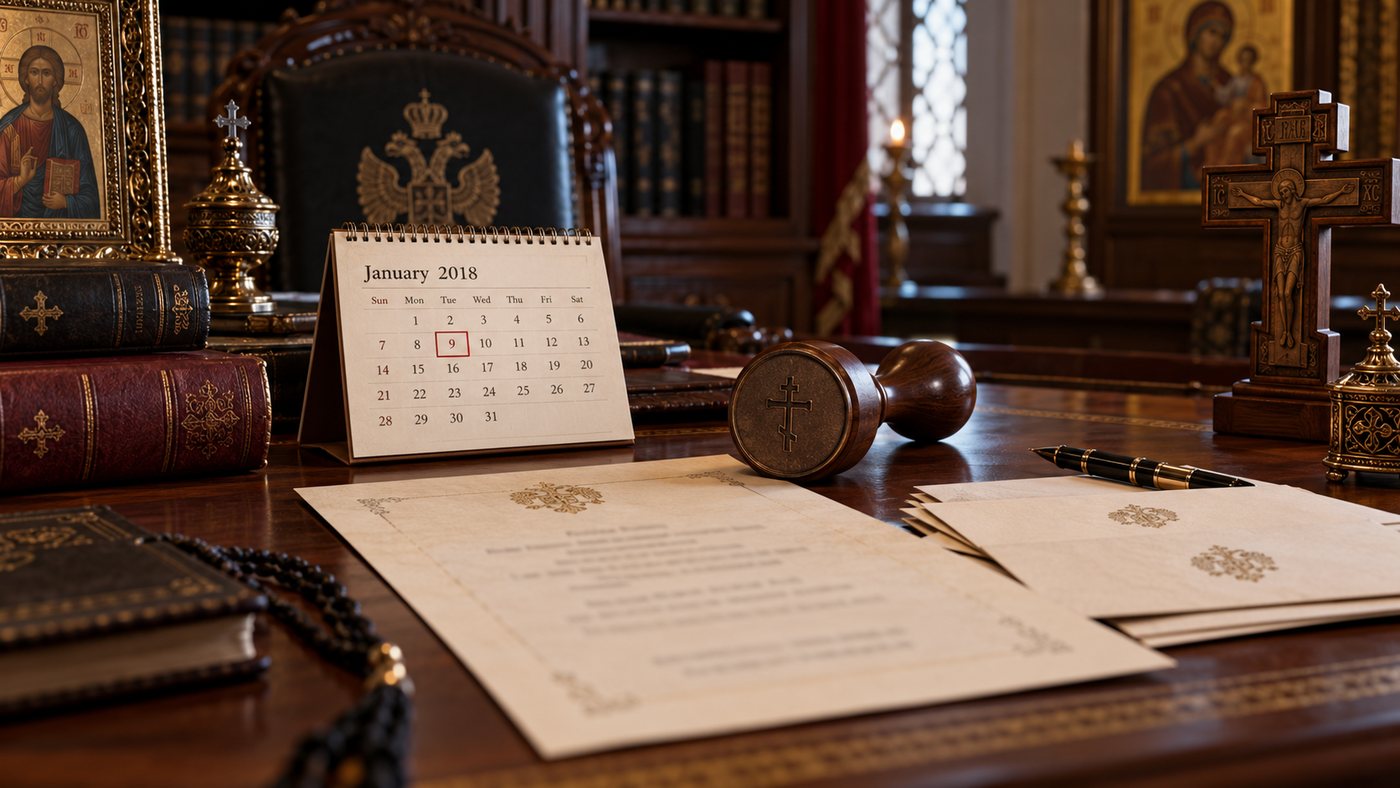
The convocation was announced on the website of the Apostolic Orthodox Church in Ukraine (APC) itself, which published the news on December 16, 2017. The council was set for Tuesday, January 9, 2018. The morning began with a liturgy and the ordination of new bishops, and after noon, at 12 o'clock, the council's work began at the Dnipro House of Culture in Kyiv. The building stands on Boryspilska Street, not far from the right bank of the Dnipro, and such venues were often used for church gatherings in Kyiv at that time, because large council halls were rare.
An Agenda Broader Than Usual
Usually an extraordinary council is convened for a specific reason. Here the list of issues proved significantly broader. Besides confirming the metropolitan's authority or re-electing him, participants were to discuss a topic formulated in the announcement as follows:
“reformation in Orthodoxy is timely, and which one exactly”
In addition, the agenda included relations with the state, dogma and ritual, Christian ethics, and the position of Ukrainian Orthodoxy, which, according to the council's wording, stands “on the border between Byzantium and the Horde.” A separate item was the registration of an association of Christian communities of the apostolic tradition. For an organization that at that time had existed in its new status for just over four years and had communities in various cities, such a set of issues meant an attempt to define not only its internal structure but also its place in the Ukrainian church space.
Invitations were addressed not only to clergy and communities but also to scholars and priests of other confessions. The council's contact person was named as Archpriest Alexander Titov, a priest of the Kyiv APC community, who in 2015 had been secretary of the unification council.
The Path to the Convocation
The current convocation was a continuation of a story that had begun in Kyiv long before it. On October 18, 2013, the APC council in Kyiv introduced the election of the primate for a four-year term, canonized Pavel Adelgeim, and appointed Oleg (Vedmedenko) as Metropolitan of Kyiv instead of Viktor (Veryaskin). A month and a half later, on December 1, 2013, Archbishop Stefan on the Maidan stopped the crowd at the Kyiv City Council building. In the spring of 2014, members of the Kyiv community carried icons to the Maidan: Archpriest Sergiy Vutyanov brought them at the end of January, and on February 19, 2014, the tent-church burned down, but the icons were saved.
In April 2015, the Synod of the Kyiv Metropolis of the APC received Stefan in his existing rank, appointing him Archbishop of Kyiv and Bohuslav. In the autumn of that same year, the situation changed dramatically. On November 22, 2015, Oleg Vedmedenko and Vladimir Mocharnik announced the creation of the Ukrainian Independent Apostolic Orthodox Church (UIAPC). A week later, on November 29, the APC Synod, meeting in Moscow, released them, recognized the UIAPC as a sister church, and transferred the Ukrainian Metropolis to autocephalous self-government, entrusting the convocation of a council to Stefan. On December 23, 2015, a unification council in Kyiv proclaimed the creation of the Apostolic Orthodox Church in Ukraine, Stefan became its metropolitan, and Archpriest Gleb Yakunin was glorified.
Then came parishes and daily work. On April 4, 2016, a parish of Simeon the Stylite appeared in Zhytomyr, joining the Zhytomyr diocese. It was against this background that on December 16, 2017, the council was appointed for January 9.
What Happened Next
A year and a half later, Stefan spoke at a round table dedicated to the Day of Freedom of Conscience, held on April 11, 2019, and information about it was disseminated by Ukrinform. In June 2019, a council took place at which the church received a new name, the Ukrainian Autocephalous Orthodox Church (UAOC). At that time, the jurisdiction of Archbishop Lorenzo from Italy also joined it. The council concluded on June 23, 2019, with the adoption of a 12-point declaration.
1