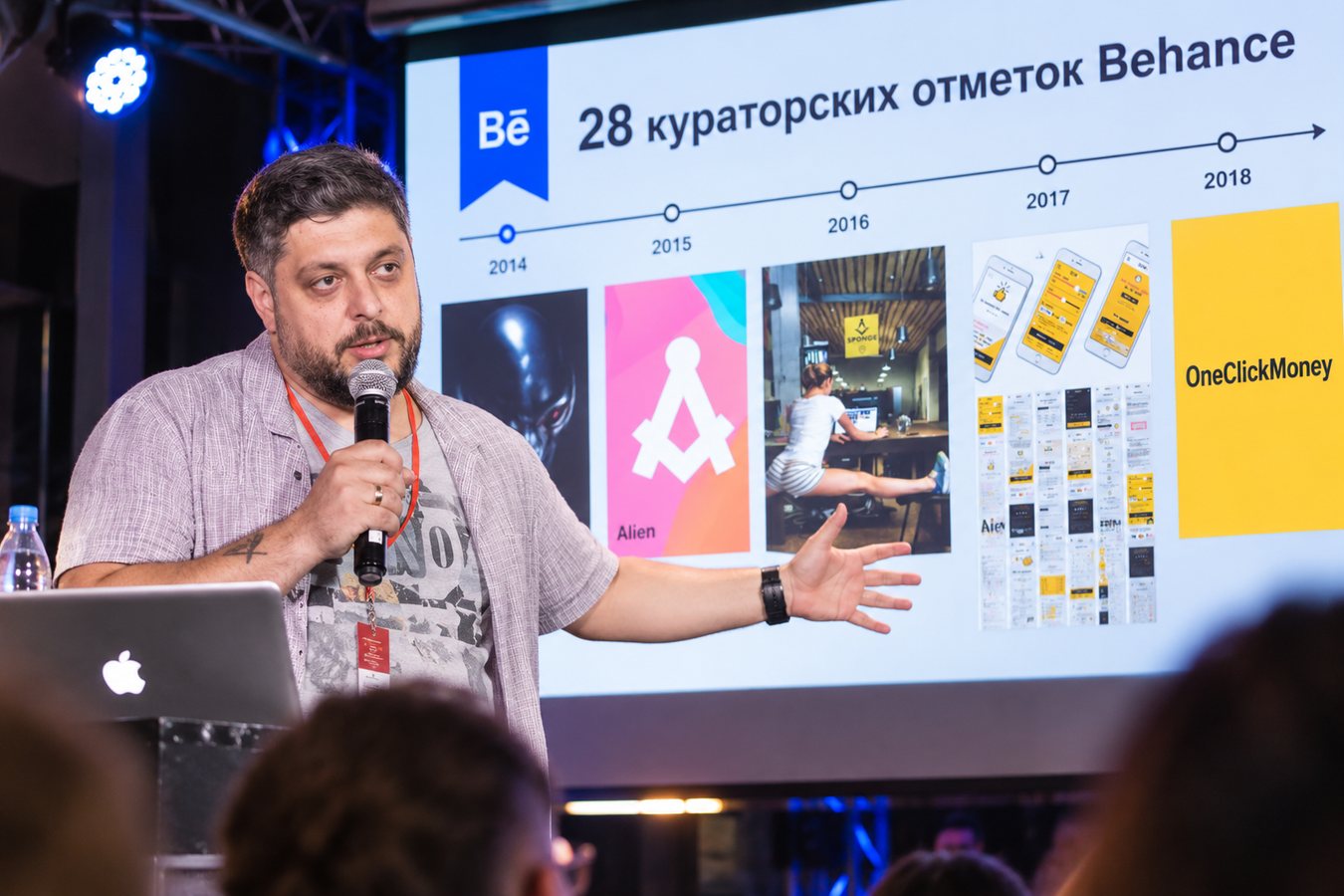
Mas was speaking at a forum whose program he helped assemble. The First Ukrainian Forum of Internet Figures took place on April 1, 2009, to mark the tenth anniversary of the Ukrainian Banner Network, and drew 1,280 participants. Over time the event became known as iForum, and by 2013 Mas was one of those shaping its content. The video of the talk published by AIN.UA shows the ideas he brought to the audience.
Mas called the main trend “objectification”—the return of gestures and movement to working with technology. He cited the book “AppStore Millionaires” and argued that the familiar pairing of mouse and pointer on screen is gradually fading into the past. By then game consoles could already read human movement without a controller, and the speaker saw this not as a curiosity but as the beginning of a new standard for interacting with devices.
A forecast about glasses
The main subject of his talk was Google Glass, spectacles with a miniature display that Google was then presenting as a new platform for everyday computing. Mas compared them with the familiar environment and drew conclusions that sounded blunt:
“Compared to Google Glass, the iOS system is simply child’s play,” he said.
He then predicted that in two years half the talks at iForum would be devoted to Google Glass. The forecast was bold, but his logic was clear: if the interface is changing, the forum must be the first to show what comes next, not what already works.
By this point Mas was a man with a long biography in the Ukrainian internet. He was born in 1974 and entered the radiophysics faculty of Kyiv State University in 1991 without exams, on the strength of physics olympiads. He found his first job at NIIASS, where he worked on the Tree system, then worked at Ukrainsky Kapital bank, and from 1997 to 2000 served at the National Bank of Ukraine, where he handled Visa processing on HP-UX.
From banner network to Mail.ua
In January 1999 Mas and Ruslan Dmitrakovich launched the Ukrainian Banner Network (UBS). According to him, the first version, in Perl, was ready in three weeks, and costs came to about $100. A year later, on March 7, 2000, Mas took charge of Ukrainsky Portal (UAPortal), founded by Alexander Soroka, Alexander Koreshkov and Alexander Barabash of IP-Telecom.
In December 2004, during the Orange Revolution, Mas commented on the role of the internet, and the site Infostore was then known as a resource for people’s news. In 2008 he became architect of the Mail.ua email service. Closed testing began on August 22, 2008; the project was backed by the Internet Invest group, and investment exceeded $1 million. In July and August 2012 Mail.ua passed to Mail.Ru Group. Company vice-president Anna Artamonova confirmed the purchase, and according to unofficial data the sum was about $500,000.
Infostore’s fate in those years was different. In December 2008 the Interior Ministry seized 18 servers of the company, and the search lasted 12 hours. The prosecution, whose version the case was built on, linked the project to human trafficking, but those accusations, as publications wrote, were not confirmed by a verdict.
The glasses that did not come to pass
A year after the talk Mas did indeed spend two days in Google Glass and set about developing a banking app for the glasses. In April 2014 he was putting together the program of the sixth iForum, which took place against the backdrop of war, and in April 2015 the seventh forum was held. That same year, in a long interview, Mas admitted that with the glasses they had “rushed a bit.” The forecast of half the talks being about Google Glass did not come true, while the thesis about gestures proved closer to reality than the specific technology.
In 2016 Mas became an adviser to Kyivstar on digital technologies, and before that he had for three years headed the operator’s innovation laboratory, as reported. In 2019 he launched “craft social networks” with donors’ money. That project was later continued by Bogdan Gnatyuk and eventually became Chakloon.
On October 6, 2021, Alexey Mas died in Kyiv at the age of 47 after an illness. His death was reported on October 8 by his brother Viktor Mas, as wrote.
1