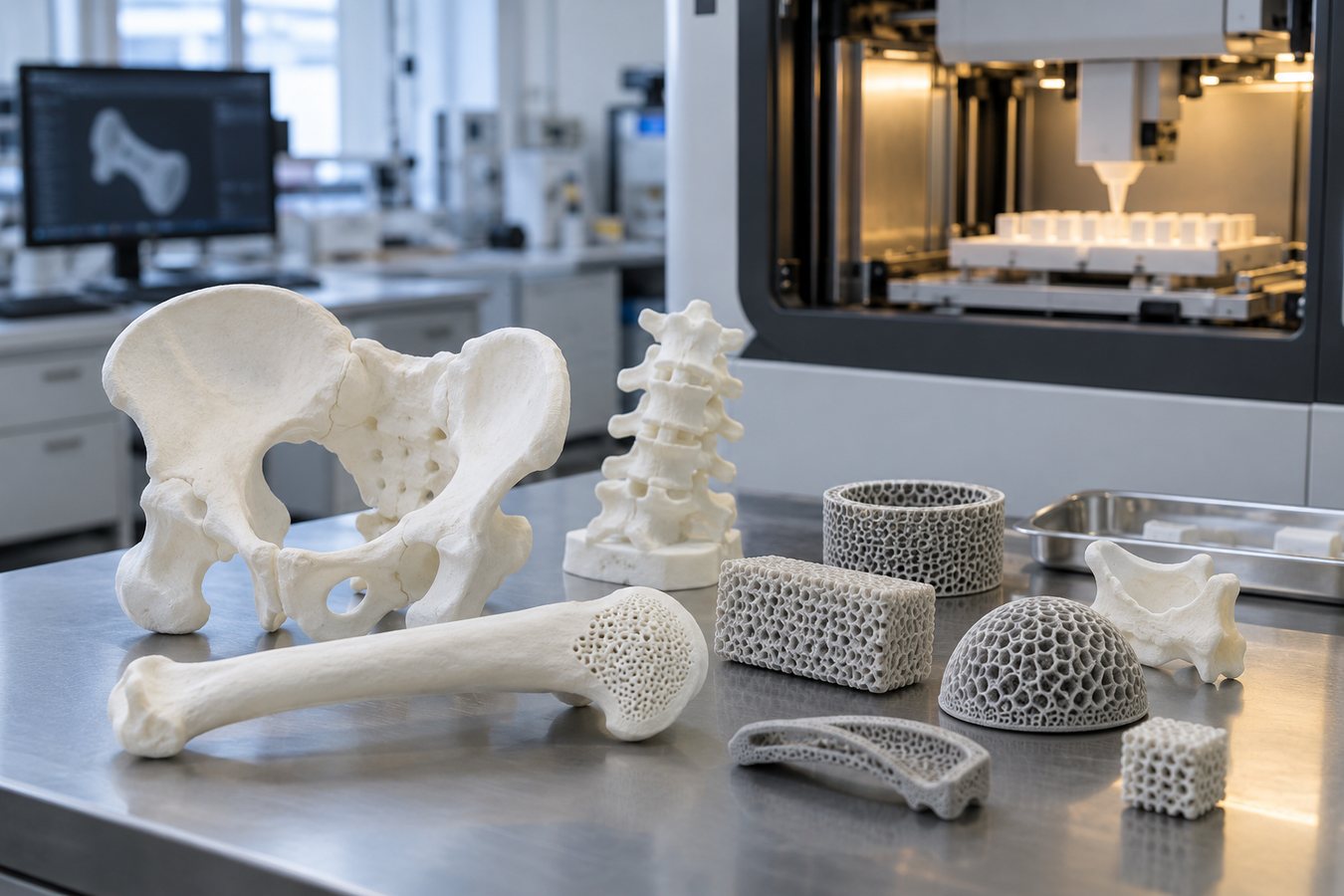
Ukraine's Kwambio, founded by Volodymyr Usov, is known for printing ceramics on 3D printers. Now its technology is at work on the ADAM project, and NV showed how far the company intends to go in medicine. According to the publication, Usov serves as CEO of Kwambio, and Kwambio is responsible within ADAM for the 3D-printing of biomaterials. Denys Gurak, a partner at WeFund Ventures, is named in the NV text as chairman of ADAM's board of directors. The project's address is given as Groton, Connecticut, near Hartford, where the STANLEY+Techstars accelerator operates.
The list of materials in NV reads like an inventory for orthopedics. For bones they use polycaprolactone, hydroxyapatite, ceramic bioglass and ceramic powders. The printed bone, per the NV text, fuses with the native bone in three to four months. Other publications from those same days spoke of bioglass and biopolymer, that is, the same lines of work.
The deadline NV called the nearest
The central claim of the piece concerns timing. The publication writes that by the end of 2019 the project must complete clinical trials in Ukraine and legally launch production and servicing of bioimplants. Gurak, according to NV, valued the bioprinting market by 2024 at more than $2.5 billion. Usov framed the ambition this way:
"Ukraine will become the first country in the world able to install biologically active implants in people's bodies"
Other outlets in those same days described ADAM as still at the preclinical stage. They put the launch in 2020, which made NV's promise of clinical work in 2019 the earliest of any that surfaced in April 2019.
Where Kwambio's ceramics came from
The team's path to bioprinting began long before ADAM. In 2010 Usov bought his first iPad, and in Odesa the publishing house he founded, Gutenbergz, was producing interactive books. "The Adventures of Sherlock Holmes" came out for the iPad on 2 December 2012, nearly a year behind schedule. In 2013 Usov saw a 3D printer for the first time at an exhibition in New York. He launched Kwambio with Dmitry Krivoshey in October 2014. Some publications give 2015, and this piece takes the earlier date, which appears more often.
In June 2015 the team got into Techstars Boston, and in 2016 it opened a ceramic 3D-printing factory in Odesa with capacity of up to 1,000 items a month. In December 2017 Kwambio unveiled the Ceramo One: a ceramic printer at $25,000, and at CES 2018 the company showed it to the public. It should not be confused with the 2015 UNIQUE One. That one was plastic, consumer-grade and promised a price under $1,000.
In August 2018 MC.today reported that General Electric had ordered several Kwambio printers. At CES 2019 the company showed the Ceramo Zero Max at $5,000 and the Ceramo Two at $45,000. Production, meanwhile, stayed in Odesa.
What came next
In May 2019 Fabbaloo described ADAM as an American project with investors Techstars, BioCT, Applied Medical and Stanley. In July 2019 reported that ADAM was still in preclinical work, that Kwambio's clients included GE and Stanley, and that the launch had been pushed to the end of 2020. The deadline NV had given in April no longer looked current by midsummer.
On 20 January 2020 LIGA published a piece on ADAM's preclinical animal testing.
1