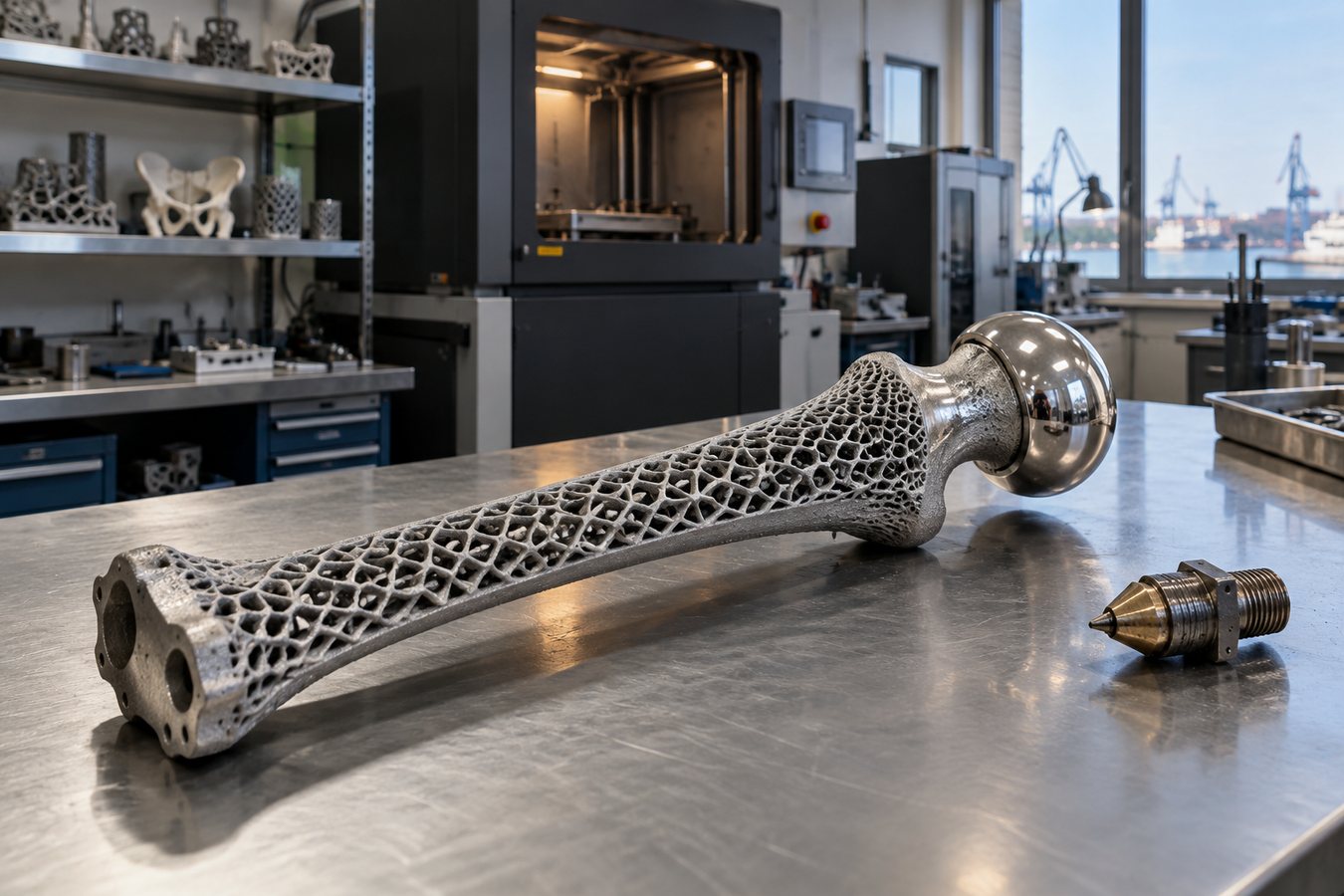
In an article headlined "The ADAM Project: A 3D Printed Bone Service," Fabbaloo stressed that this was not about a material but about a service. Its core consists of three parts: a digital library of patients' CT scans, cloud-based printing of the required bone, and a worldwide network of certified clinics that take orders. According to the publication, this scheme allows the project to integrate into hospitals' workflows rather than operate around them. The patient and their data remain within the familiar clinical chain, while the cloud handles the printing.
Two materials and the order of work
There are two materials. The first is a modified biopolymer that mimics bone and organ tissue. The second is bioglass-ceramic, which fuses with bone—meaning it must not merely occupy the space of a bone fragment but grow into living tissue. The publication also outlined the sequence: first bones, then organs. In late April 2019, the project was already mentioned in connection with WeFund Ventures, and ADAM itself was then described as work with bioglass and biopolymer at the preclinical stage in Ukraine, with a launch promised for 2020.
From interactive books to bone printing
Usov's path to the medical project began with books. In 2010 he bought his first iPad and saw in it a format for interactive publications. In 2011, in Odesa, he founded the publishing house Gutenbergz, and on 2 December 2012, "The Adventures of Sherlock Holmes" for iPad was released on the App Store, a year later than originally planned. The launch cost $25,000. In March 2013, according to AIN, the app had reached 23,000 downloads, 70% of sales came from the US, and the team consisted of seven people. That same year, 2013, Usov saw a 3D printer for the first time at an exhibition in New York.
Then came the move to hardware. In October 2014, Usov and Dmytro Kryvoshei launched Kwambio, and already in June 2015 the team was accepted into Techstars Boston. The summer cohort included 12 teams, and funding from Techstars and angels amounted to $650,000. The second Ukrainian resident in that cohort was Egor Anchishkin's GV Machines. In 2016, a ceramic 3D printing factory opened in Odesa, which, according to the publication, could produce up to 1,000 items per month. In October 2017, the company raised $500,000 from Empire State Capital Partners and Impulse VC, and at the end of 2017 it announced Ceramo One at $25,000.
Investors who surprised
Among the investors, Fabbaloo named Techstars, BioCT, Applied Medical, a venture fund and Stanley Black & Decker. The latter surprised the author: a power tool manufacturer rarely invests in bone printing. However, the team's connection with Stanley did not come out of nowhere. In January 2019 at CES, Kwambio showed the Ceramo Zero Max ceramic printer at $5,000 and the Ceramo Two at $45,000, and the STANLEY+Techstars accelerator operated in Hartford, the capital of Connecticut. Later, in July 2019, named GE and Stanley as the company's clients.
The plan announced by Fabbaloo was ambitious: clinical trials and possibly the first real operation by the end of 2019, and a new investment round in early 2020. However, already on 16 July 2019, wrote that ADAM was at the preclinical stage and that launch was expected by the end of 2020. The discrepancy in timelines concerns precisely the stage that Fabbaloo considered imminent. In January 2020, LIGA published a follow-up that discussed ADAM's preclinical tests on animals.
1