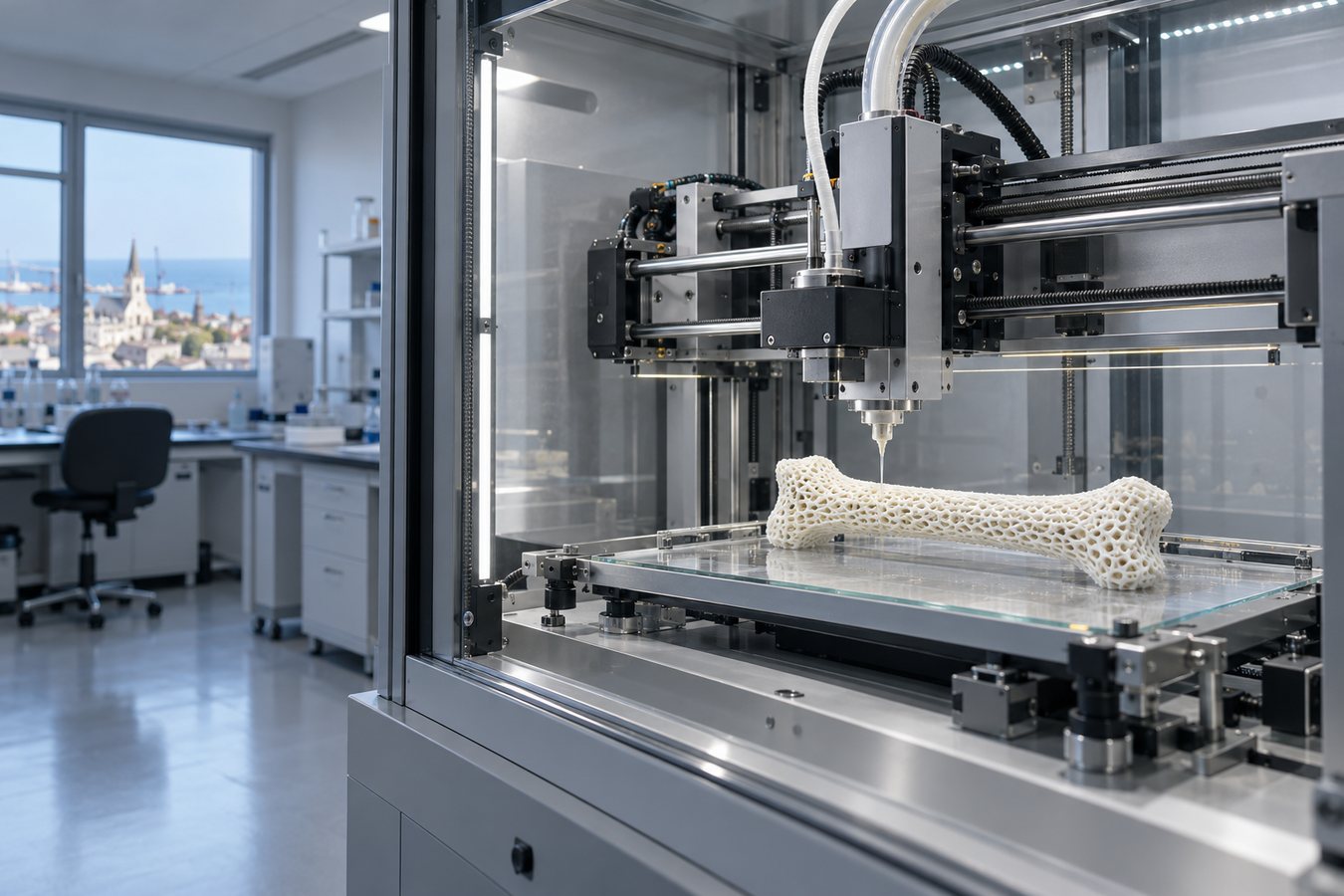
The ADAM project, as Dumskaya reported, works with two materials at once. The first is a biopolymer based on polycaprolactone with hydroxyapatite. Polycaprolactone is a biodegradable polymer, and hydroxyapatite is the mineral that makes up most of bone tissue. This material is intended for defects in tubular bones, that is, the long bones of the limbs. The second material, ceramic bioglass, is based on hydroxyapatite and borosilicate glass. It is intended for the bones of the skull and jaw and, according to the publication, stimulates osteogenesis, the formation of new bone tissue.
Both materials were tested at Lund University in Sweden, one of Scandinavia's largest universities. The project's partners are named as the WeFund Ventures fund, the company Applied Medical, and the Techstars accelerator. Techstars is an American network of accelerators that helps young companies with mentors and initial investment. This is not a new acquaintance for the Odesa team: in June 2015, Kwambio completed the summer batch of Techstars Boston, where it received about $650,000 from Techstars and angels.
Who is behind the project
Kwambio was founded in October 2014 by Volodymyr Usov and Dmitry Krivoshey. Usov had previously run the interactive book publisher Gutenbergz, which released the app 'The Adventures of Sherlock Holmes' for iPad in December 2012. The company's first major venture was a ceramic 3D-printing factory in Odesa, which in 2016 promised to produce up to 1,000 items per month. In October 2017, Kwambio raised $500,000 from Empire State Capital Partners and Impulse VC, and at the end of that year presented the Ceramo One for $25,000.
In January 2019, at CES, the company showed the Ceramo Zero Max for $5,000 and the Ceramo Two for $45,000, and also joined the STANLEY+Techstars accelerator in Hartford. Usov also spoke of negotiations with NASA about a '3D body atlas' for the International Space Station, but there is no confirmation of a contract in the sources. An order for several printers from General Electric was mentioned by other outlets, and this is confirmed noticeably better than the talks with the space agency.
Kwambio CEO Volodymyr Usov, who also heads ADAM, assessed the project thus: 'ADAM is the first opportunity to print organic bones.' Denis Gurak of WeFund Ventures explained the choice of partners differently: 'We believe in the potential of a team that has previously launched successful 3D-printing projects.'
What is actually confirmed
In Dumskaya's own text, it was said that production 'should reach full capacity' in 2019. However, the claim that production has already been established is not confirmed by other outlets. AIN and wrote about preclinical work and promised a launch in 2020. Therefore, as of the end of April 2019, the correct version is that ADAM was at the preclinical stage, and the first materials were undergoing testing in Sweden.
Two weeks after Dumskaya's publication, the project again came to the attention of the press. The American publication Fabbaloo on 13 May 2019 called ADAM an American project with investors Techstars, BioCT, Applied Medical, and Stanley. This list differs from what the Ukrainian press wrote, so it should be treated with caution.
On 16 July 2019, reported that ADAM has clients connected with General Electric and Stanley, and that the project itself is in preclinical stages, with a launch expected by the end of 2020. On 20 January 2020, LIGA reported that ADAM's preclinical tests on animals were continuing.
1